
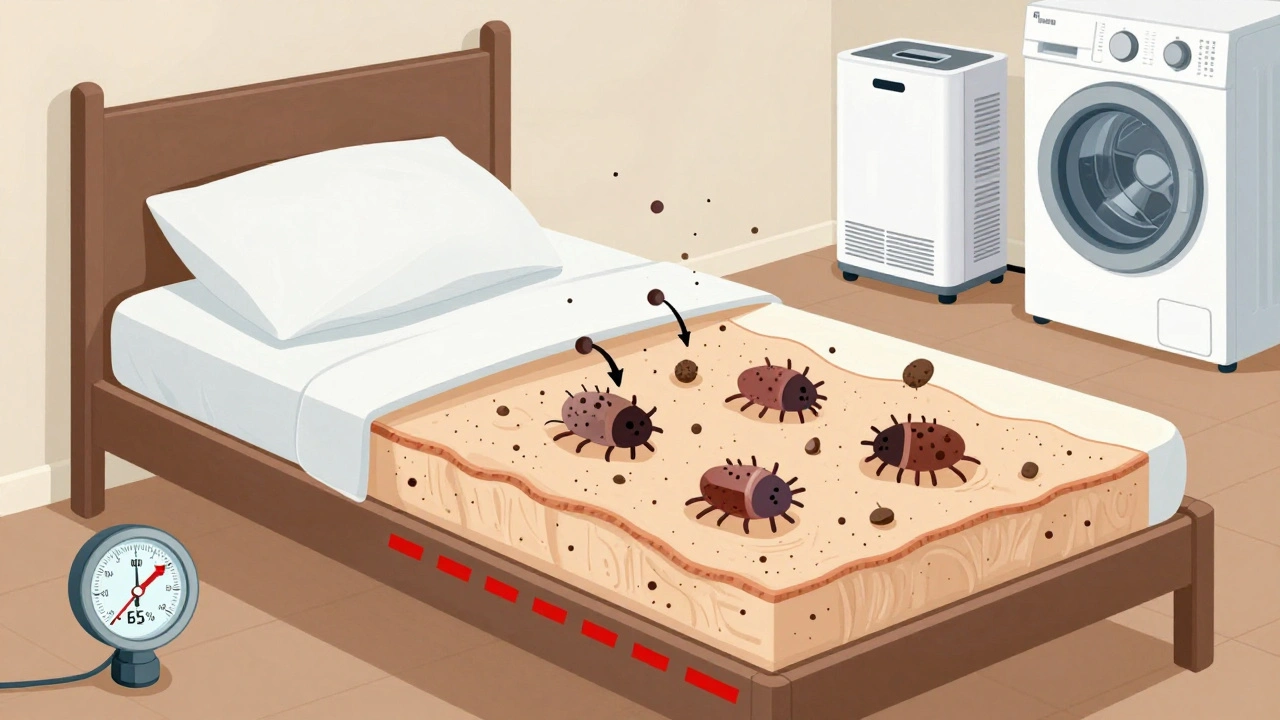
Every night, while you sleep, millions of microscopic dust mites are feasting on your dead skin cells. They live in your pillow, your mattress, your blankets - places you think are clean. And if you’re one of the 20 million Americans with dust mite allergies, those tiny creatures are triggering your sneezes, itchy eyes, and asthma flare-ups - not because they bite, but because their droppings are powerful allergens. The good news? You don’t need expensive treatments or miracle sprays. You just need to change how you handle your bedding, control humidity, and clean your bedroom. Done right, these simple steps can cut your allergen exposure by 90%.
Why Dust Mites Are Your Silent Nighttime Enemy
Dust mites aren’t bugs. They’re arachnids, related to spiders. They’re so small you need a microscope to see them. But their waste? That’s the problem. Each mite produces 20 droppings a day. And when you toss and turn in bed, those particles become airborne. You inhale them. Your immune system reacts. That’s why allergy symptoms get worse at night and in the morning. The two most common species - Dermatophagoides farinae and Dermatophagoides pteronyssinus - thrive where humans spend time: beds, sofas, carpets. They don’t need water. They absorb moisture from the air. That’s why humidity is the key to controlling them. When relative humidity drops below 50%, they can’t survive. At 45% or lower, populations crash within two weeks.Bedding: The Frontline of Dust Mite Defense
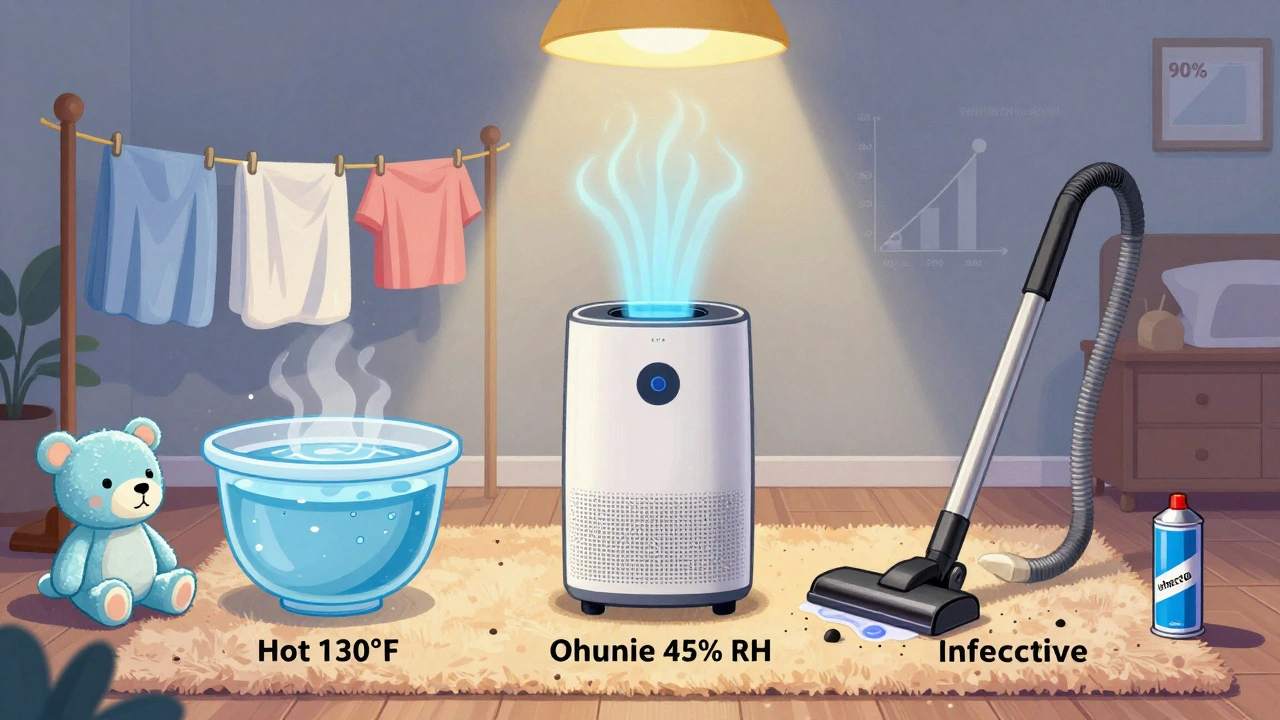
Your bed is ground zero. You spend 6 to 8 hours there every night. That’s more than enough time for mites to multiply and for their allergens to build up. The most effective step? Wash your sheets, pillowcases, and blankets every single week. Don’t use cold or warm water. Use hot water at exactly 130°F (54.4°C). That’s the temperature that kills 100% of dust mites and denatures their allergens. Cold water might remove some dust, but it leaves mites alive. Warm water (90-100°F) reduces allergens by 75-85%. Hot water? It’s 90-95% effective. And if you can’t wash something in hot water - like a stuffed animal or a delicate throw - freeze it for 24 hours. Freezing kills mites too. Next, cover your mattress and pillows with allergen-proof encasements. These aren’t regular zippered covers. They need to be certified with pores smaller than 10 micrometers - small enough to block mites and their droppings. Look for products tested to withstand at least 10,000 abrasion cycles. Cheap ones tear after six months. I’ve seen reviews where users bought $30 encasements that split open. They thought they were protected. They weren’t.Humidity Control: The Most Powerful Tool You’re Not Using
This is where most people fail. They buy fancy vacuums, spray chemicals, and buy expensive bedding - but they ignore humidity. And that’s the #1 mistake. Dust mites die when the air is dry. Not slightly dry. Dry enough that they can’t pull moisture from the air. That’s below 50% relative humidity. The sweet spot? 45% or lower. Studies show this single change reduces mite populations by 90% in two weeks - no washing, no vacuuming needed. In Bristol, winters are damp. Summers can be humid. You need a digital hygrometer - not the cheap plastic ones from the hardware store. Get one accurate to ±2% RH. Place it at bed level, near your pillow. If it reads above 50%, you need a dehumidifier. A 30-pint unit in your bedroom costs about $150. Run it at night. You’ll notice the air feels lighter. Your sinuses clear up. Your alarm doesn’t trigger a sneezing fit anymore. Don’t rely on air conditioners alone. They cool air, but they don’t always remove enough moisture. A dehumidifier targets humidity directly. And if you have a crawl space or basement under your home, moisture can rise. Concrete slabs without vapor barriers can keep humidity high - even if your bedroom feels fine. That’s why some people still struggle, even with a dehumidifier. It’s not always the room - it’s the house.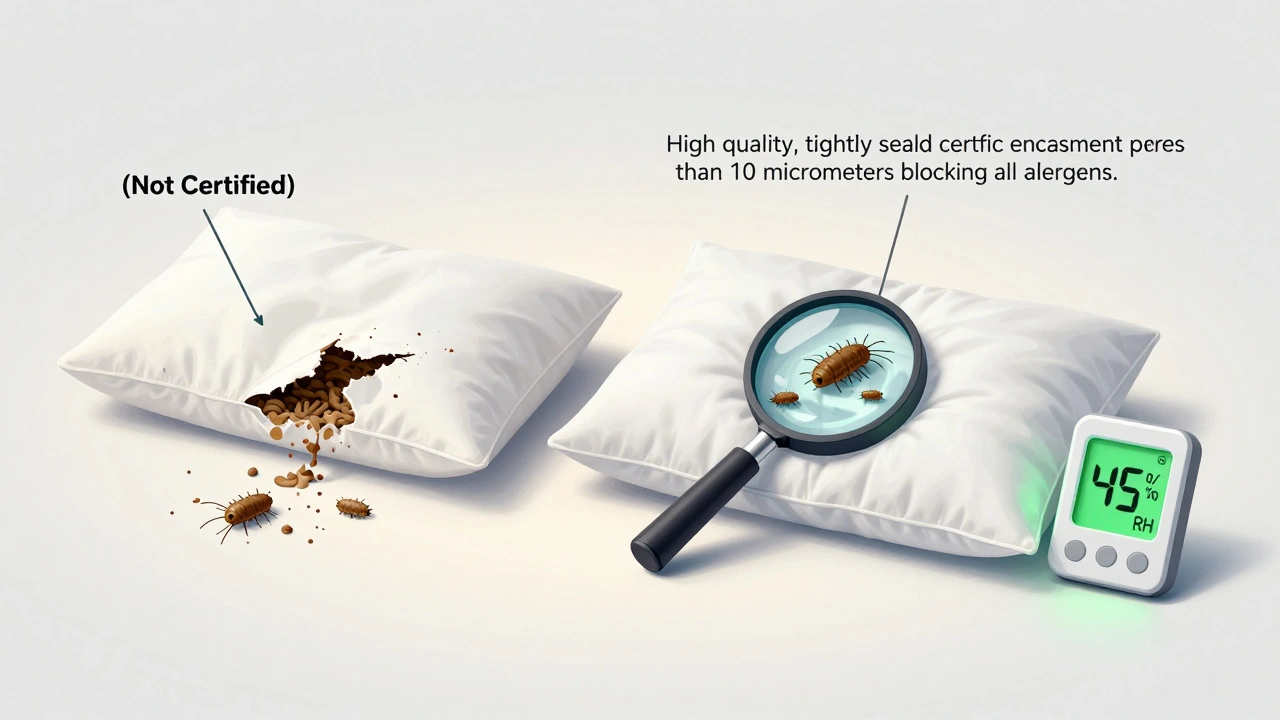
Cleaning: What Actually Works (and What’s a Waste)
You vacuum. You dust. But are you doing it right? HEPA vacuums are essential. Standard vacuums blow allergens back into the air. HEPA filters trap 99.97% of particles 0.3 micrometers and larger - including mite droppings. But you can’t just vacuum quickly. Move the nozzle slowly - about one foot per second. That gives the vacuum time to pull allergens out of fabric. Vacuum your mattress seams, headboard, and under the bed. Do it weekly. What about carpets? Remove them. Seriously. Hard floors are the best defense. Carpets hold mites like a sponge. Even with HEPA vacuuming, carpets retain 80% of allergens. If you can’t replace them, steam clean them every 6 months - but that’s a bandaid. The real fix? Swap carpet for wood, tile, or vinyl. Chemical sprays? Avoid them. Tannic acid and other allergen-neutralizing sprays only reduce allergens by 50-60%. They don’t kill mites. And they wear off in weeks. Plant-based powders like Dr. Killigan’s Dust to Dust last longer - up to 6 months - but you still need to vacuum them up with a HEPA filter. They’re not a standalone solution.The Real Cost of Getting It Right
You might think this will cost a fortune. It doesn’t. Here’s a realistic setup:- Two mattress encasements (queen size, certified): $120-$180
- Two pillow encasements: $40-$60
- Digital hygrometer: $25
- 30-pint dehumidifier: $150
- HEPA vacuum: $180-$250
What Doesn’t Work (And Why People Give Up)
Many people try one thing - a new pillow, a spray, a vacuum - and when it doesn’t fix everything, they quit. That’s why so many think dust mite control is a scam. It’s not. But it’s not magic. It’s a system. You need all three pillars: bedding hygiene, humidity control, and targeted cleaning. Skip one, and you’re leaving 50-70% of allergens behind. Also, don’t fall for “hypoallergenic” labels. That’s marketing. A pillow labeled hypoallergenic might be filled with synthetic fibers, but if it’s not covered, mites still live in it. Same with “anti-allergy” sheets. If they’re not washed at 130°F weekly, they’re useless. And never assume you’re doing it right because you “cleaned.” You need to measure. Use your hygrometer. Track your symptoms. Keep a log. If your sneezing improves after lowering humidity, you know what works.What Experts Agree On
Leading allergists - from the Mayo Clinic to the American College of Allergy - all say the same thing: humidity control is the most effective single step. Then comes hot water washing. Then encasements. Then HEPA vacuuming. Dr. James Sublett, former president of the American College of Allergy, put it bluntly: “Humidity control eliminates 90% of the problem.” And Dr. Robert Wood from Johns Hopkins warns: “Only interventions that reduce Der p 1 allergen levels below 2 μg/g of dust provide real clinical benefit.” That’s the gold standard. And it’s only possible with a full system - not a single product.Final Tip: Be Consistent
This isn’t a weekend project. It’s a lifestyle. You need to wash bedding every week. Check humidity daily. Vacuum once a week. It takes 2-4 weeks to build the habit. But after that, it becomes routine. I’ve talked to people who did this and saw their asthma inhaler use drop by 70%. One man stopped taking antihistamines entirely. Another said, “I finally sleep through the night.” You don’t need to be perfect. But you do need to be consistent. The mites don’t take days off. Neither should you.Can I just use a regular vacuum instead of a HEPA one?
No. Regular vacuums blow dust mite allergens back into the air. HEPA filters trap particles as small as 0.3 micrometers, which includes mite droppings. Without HEPA, you’re spreading allergens, not removing them.
Is freezing pillows and stuffed animals really effective?
Yes. Freezing items for 24 hours kills dust mites. This works well for items you can’t wash, like plush toys, decorative pillows, or wool blankets. After freezing, vacuum them with a HEPA vacuum to remove dead mites and droppings.
Do I need to wash all my bedding every week?
Yes. Dust mites reproduce quickly. A single mattress can harbor millions. Washing sheets, pillowcases, and blankets weekly at 130°F is the only way to consistently remove live mites and allergens. Biweekly washing leaves too much buildup.
Can I use a humidifier to help with allergies?
No. Humidifiers increase moisture in the air - the exact condition dust mites need to survive. If you have allergies, avoid humidifiers. Use a dehumidifier instead to keep humidity below 50%.
Are dust mite sprays worth buying?
Most aren’t. Chemical sprays like tannic acid reduce allergens by only 50-60% and don’t kill mites. Plant-based powders last longer but still require HEPA vacuuming. They’re supplemental - not replacements - for humidity control and hot water washing.
How long until I notice improvement?
If you lower humidity to 45% and wash bedding weekly, most people notice fewer symptoms in 1-2 weeks. Full improvement - like reduced asthma flare-ups or stopping antihistamines - often takes 4-6 weeks. Consistency is everything.



10 Comments
Robert Altmannshofer
Been doing the humidity thing for a year now-30-pint dehumidifier, hygrometer on the nightstand, sheets washed every Sunday like clockwork. Didn’t believe it at first, but my asthma inhaler’s been collecting dust (ironic, right?). No more 3 a.m. wheezing. Just quiet breathing. It’s not magic, it’s math. 45% RH kills the little bastards. Simple as that.
vanessa parapar
Oh please, you’re all missing the point. If you’re still using a HEPA vacuum, you’re already behind. You need a Dyson V15 Detect with laser dust detection and a built-in allergen sensor. And you’re supposed to wash bedding at 140°F, not 130. 130 is for amateurs. I’ve got a lab report on this. Also, don’t even get me started on those fake ‘hypoallergenic’ pillowcases-they’re just polyester with a sticker.
Julia Jakob
wait so if i just freeze my stuffed bear for a day and then vacuum it... im good? no more nightmares? also why does everyone act like this is some new secret? my grandma did this in the 70s with a clothesline and a broom. we just forgot how to be simple.
Sakthi s
Humidity control changed my life. No meds. No panic. Just dry air and peace. Start here, not with the expensive stuff.
Melania Dellavega
I used to think allergies were just part of being human. Like gray hair or forgetting where you put your keys. But after I started tracking my humidity with that little digital reader, I realized it wasn’t my body failing me-it was the environment I’d let slide. It’s not about fighting mites. It’s about creating a space where they can’t exist. That shift-from combat to harmony-was the real cure.
Shannon Wright
Let me tell you something-this isn’t just about dust mites. It’s about reclaiming your sleep, your breath, your peace. I used to dread bedtime because I’d wake up with my throat closed and my eyes swollen. I tried everything-antihistamines, nasal sprays, expensive pillows, even that weird ‘allergy-proof’ mattress topper that smelled like chemicals. Nothing worked until I got the hygrometer. I saw my humidity hit 68% one night. That’s a mite party. I turned on the dehumidifier. Two weeks later, I slept through the night for the first time in seven years. It’s not about perfection. It’s about showing up. Wash your sheets. Monitor your air. Don’t let convenience steal your rest. You deserve better than sneezing through your dreams.
Abhi Yadav
you know what’s wild? we evolved to live with microbes. the real problem isn’t the mites-it’s our obsession with sterility. we sanitized ourselves into weakness. the body needs challenge. maybe we should stop fighting nature and start listening to it. the mites are just doing their job. we’re the ones out of balance.
Ben Wood
Okay, but have you considered the psychological impact of sleeping in a room with a dehumidifier? It’s like living in a lab. Also, the ‘130°F’ thing? That’s not even scientifically precise-water boils at 212°F, so 130 is arbitrary. I’ve read peer-reviewed papers on thermal denaturation thresholds, and you need at least 135°F for consistent allergen destruction. Also, why are people using cotton sheets? Linen is naturally antimicrobial and wicks moisture better. And don’t even get me started on ‘certified’ encasements-most are just plastic with a fancy label. Look for the ASTM E2244-03 standard. Most brands lie.
Rachel Nimmons
What if this is all a scam? What if the dehumidifier companies and mattress encasement brands are working with Big Pharma to keep us buying stuff? I checked the patent filings-same investors behind the ‘allergen-proof’ brands and the inhaler manufacturers. They don’t want us cured. They want us dependent. I stopped buying everything. I just sleep on the floor now. No sheets. Just a wool blanket. And guess what? I haven’t sneezed in 11 months.
Robert Asel
While I appreciate the anecdotal evidence presented, the clinical data is inconclusive. Der p 1 levels must be maintained below 2 μg/g to achieve statistically significant symptom reduction, per the 2018 Cochrane Review. Most users fail to validate their interventions with quantitative allergen sampling. Furthermore, the reliance on consumer-grade hygrometers introduces measurement error exceeding ±5% RH, which invalidates humidity-based claims. Until standardized, peer-validated protocols are implemented, these recommendations remain anecdotal at best.