

Antibiotic Stewardship Decision Simulator
Patient Scenario
Clinical Impact
Select a prescribing approach to see how stewardship changes the outcome.
Imagine taking a medication to clear up a lung infection, only to end up with a life-threatening case of severe diarrhea that lands you back in the hospital. It sounds paradoxical, but this happens more often than you'd think. The culprit isn't always the drug itself, but how it's used. When we use antibiotics unnecessarily or choose the wrong one, we aren't just fueling "superbugs"; we are actively inviting dangerous side effects into our bodies.
This is where Antibiotic Stewardship is a coordinated effort to measure and improve how antibiotics are prescribed by clinicians and used by patients. Essentially, it's about getting the right drug, at the right dose, for the right bug, and for the exact right amount of time. While it sounds like a bureaucratic hospital process, it is actually a critical safety net that protects you from avoidable harm.
Why "Just in Case" Antibiotics Are Dangerous
You've probably heard that taking antibiotics when you don't need them-like for a viral cold-leads to Antimicrobial Resistance. While that is a massive global threat, the immediate danger to the individual is the disruption of the body's natural balance. Your gut is home to trillions of "good" bacteria that keep your immune system in check and prevent harmful pathogens from taking over.
When you take a broad-spectrum antibiotic unnecessarily, it acts like a wildfire, wiping out both the bad and the good bacteria. This creates a biological vacuum. One of the most notorious opportunists in this scenario is Clostridioides difficile (often called C. diff), a bacterium that causes severe inflammation of the colon and life-threatening diarrhea. Research shows that inappropriate antibiotic use can increase your risk of a C. diff infection by 7 to 10 times. By practicing strict stewardship, hospitals have seen these infection rates drop by as much as 30%.
The Pillars of Appropriate Use
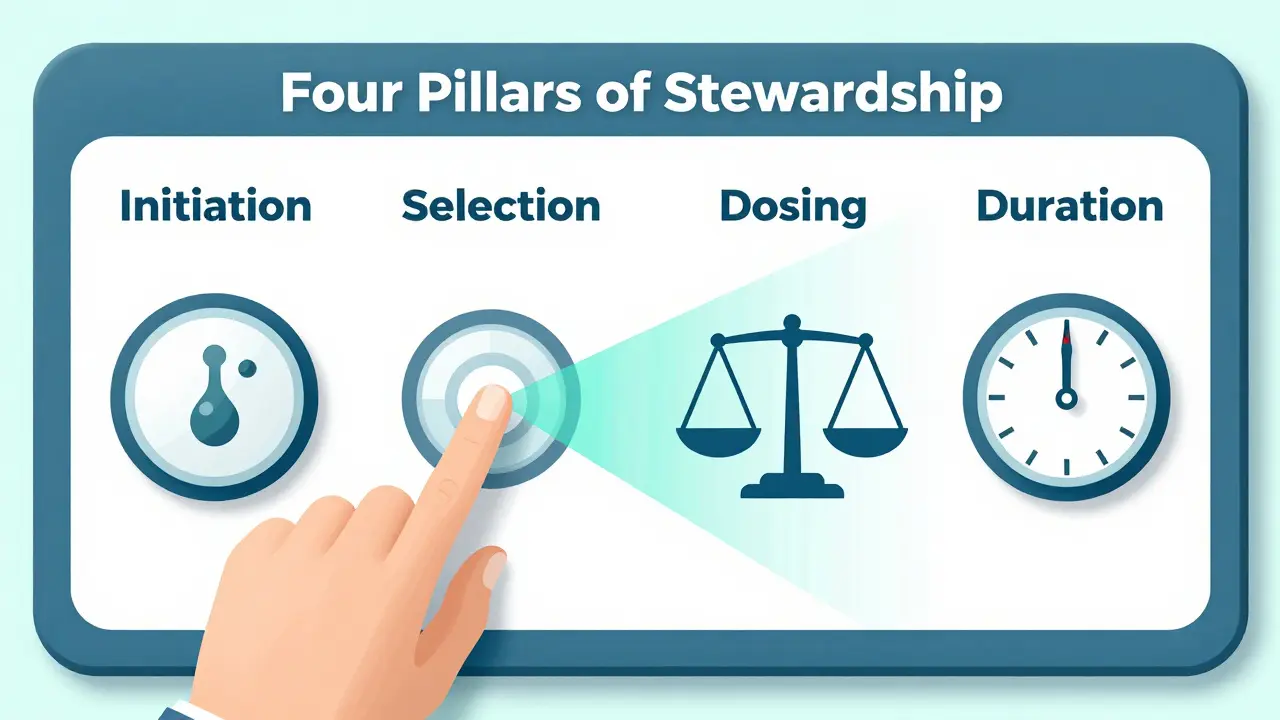
Stewardship isn't just about saying "no" to a prescription; it's about making a precise clinical decision. To reduce side effects, medical teams focus on four key decisions:
- Initiation: Do you actually need an antibiotic? Using biomarker tests, like measuring procalcitonin levels, helps doctors determine if an infection is bacterial or viral, potentially shaving days off unnecessary treatment.
- Selection: Choosing a narrow-spectrum drug that targets the specific germ rather than a "nuclear option" broad-spectrum drug that destroys your microbiome.
- Dosing and Route: Ensuring the dose is high enough to kill the bug but not so high that it damages the kidneys or liver.
- Duration: Stopping the medication the moment the infection is cleared. Every extra day of treatment is another day your body is exposed to potential side effects.
| Metric | Traditional Approach | Stewardship Approach | Estimated Improvement |
|---|---|---|---|
| C. diff Infection Risk | High (7-10x increase) | Controlled/Reduced | 25-30% reduction in cases |
| Adverse Drug Events | Higher baseline risk | Targeted therapy | ~21.5% reduction in hospitals |
| Treatment Duration | Fixed course (e.g., 10 days) | Dynamic (based on recovery) | 1.6 to 3.5 days shorter |
How Stewardship Works in the Real World
In a high-pressure environment like an Intensive Care Unit (ICU), doctors often face a terrifying choice: wait for a lab result that takes two days, or start a massive dose of broad-spectrum antibiotics immediately to save the patient's life. This "fear of the unknown" often leads to over-prescription. Prospective Audit and Feedback is a technique where clinical pharmacists review prescriptions in real-time and provide suggestions to the doctors to narrow the therapy as soon as lab results come back.
For those outside the hospital, stewardship happens in clinics and emergency rooms. The Centers for Disease Control and Prevention (CDC) has noted that millions of unnecessary antibiotic prescriptions are written in outpatient settings every year. When a doctor explains why an antibiotic isn't needed for your flu-and perhaps provides a checklist for managing symptoms instead-that is stewardship in action. It protects you from the immediate risk of an allergic reaction or a gut imbalance.
The Trade-offs and Challenges
If stewardship is so effective, why isn't it everywhere? The biggest hurdle is resources. A successful hospital program requires dedicated experts, usually a combination of an Infectious Diseases Physician and a specialized clinical pharmacist. These professionals aren't just checking boxes; they are analyzing complex microbiology reports to pivot treatment mid-stream.
There is also a psychological barrier. Many prescribers worry that stopping an antibiotic too early might lead to a relapse. However, data suggests that when stewardship is guided by rapid molecular testing, patients recover just as well-if not better-because they avoid the "secondary hit" of a medication-induced illness like colitis.

Looking Toward a Safer Future
The landscape is changing. We are moving away from the "one size fits all" 10-day course of pills. The future of reducing side effects lies in personalized medicine. We are seeing the integration of artificial intelligence to analyze patient data in real-time, alerting doctors the moment a drug becomes unnecessary.
Moreover, the push for diagnostic stewardship means we are getting better at identifying the exact strain of bacteria in hours rather than days. This allows for "surgical precision" in prescribing-hitting the pathogen hard while leaving the rest of your body's healthy bacteria untouched. By treating antibiotics as a precious, finite resource rather than a commodity, we not only save the drugs for future generations but keep the current generation of patients much safer from preventable harm.
Does antibiotic stewardship mean I won't get antibiotics when I need them?
Not at all. Stewardship isn't about denying treatment; it's about optimizing it. The goal is to ensure you get the most effective drug for your specific infection, which actually increases your chances of a faster recovery and reduces the risk of side effects.
What are the most common side effects that stewardship helps prevent?
The most significant is Clostridioides difficile (C. diff) infection, which causes severe diarrhea and colitis. Other preventable harms include acute kidney injury from improperly dosed medications and severe allergic reactions to broad-spectrum drugs that could have been avoided with a more targeted choice.
How can I tell if my doctor is practicing antibiotic stewardship?
A doctor practicing stewardship will often explain why an antibiotic is or isn't necessary. They may order specific tests (like a culture or procalcitonin) before prescribing, or they might tell you to wait a few days to see if a viral infection clears on its own before starting medication.
Why is the ICU the main focus for these programs?
ICUs use a disproportionate amount of the hospital's antibiotics, often the strongest and broadest types. Because ICU patients are already critically ill, the risk of a severe side effect or a secondary infection like C. diff is much higher and more dangerous.
Is antibiotic stewardship only for hospitals?
While it started in hospitals, it is now expanding to outpatient clinics, nursing homes, and emergency departments. Reducing unnecessary prescriptions in doctor's offices is now a primary goal to prevent community-acquired resistance and side effects.
Next Steps for Patients and Caregivers
If you are prescribed an antibiotic, you can participate in stewardship by asking a few simple questions: "Is this antibiotic necessary for my specific symptoms?", "Is there a narrower-spectrum option that would be safer for my gut health?", and "How will we know when it's time to stop this medication?"
For those managing care for elderly relatives in long-term facilities, be aware that these settings often have lower stewardship rates than hospitals. Advocating for a pharmacy review of their medications can help prevent the "prescribing cascade" where antibiotics are given for symptoms that might actually be side effects of other drugs.




11 Comments
Goodwin Colangelo
This is a solid breakdown of a complex topic. Most people don't realize that a 'broad-spectrum' drug is basically a sledgehammer when a scalpel would do. If you're ever in the hospital, don't be afraid to ask your nurse if the pharmacy has reviewed your meds for 'de-escalation'-that's the industry term for narrowing the drug once the culture results are in. It really can make a difference in how fast you get home.
simran kaur
Funny how they call it 'stewardship' to make it sound like they're protecting us. In reality, it's just a way for hospitals to cut costs by reducing the duration of expensive drug treatments under the guise of 'safety.' They want us to believe in these 'biomarker tests' while they're probably just using the same outdated software for everything. It's all about the bottom line and controlling the population's health through curated prescriptions. Pure corporate greed masquerading as science.
sophia alex
Imagine thinking some foreign-inspired 'stewardship' is better than the raw power of American medicine!! 🇺🇸 We have the best doctors in the world and we don't need these bureaucratic checklists slowing them down. This whole post feels like it's trying to make our healthcare system look weak. Absolute joke 🙄💅
Divine Manna
The fundamental error in the common perception of antibiotics is the failure to recognize the ontological difference between a pathogen and a commensal organism. One does not simply 'take a pill'; one alters an entire biological ecosystem. The adherence to a fixed ten-day course is a relic of early twentieth-century heuristics, devoid of the nuance required for modern clinical excellence. We must transcend the simplistic binary of 'sick versus healthy' and embrace the systemic complexity of the human microbiome if we are to avoid total biological collapse.
Mark Zhang
I really appreciate how the post mentions the psychological barrier for doctors. It's scary for them too, not wanting a patient to relapse. It's all about finding that balance and trusting the data.
Jenna Carpenter
People just dont get that the gut is the second brain... if you wreck your flora with these drugs you're basicly erasing your intuishun and emotional stability. Stewardship is just a bandaid on a broken sistem that refuses to look at holistic healing!!!
Brian Shiroma
Oh sure, because we all know how much doctors love spending extra time explaining things to patients instead of just writing a script and kicking us out the door in fifteen minutes. I'm sure the 'stewardship' approach is working wonders in the waiting rooms where we spend half our lives.
Rachelle Z
Wait... so you're telling me the meds that are supposed to fix me might actually break me... how convenient!!! 🙃✨ I love how we just keep finding new ways to be stressed about our health!!!! ❤️❤️❤️
Branden Prunica
My god, the thought of C. diff is actually haunting me now. I had a 'simple' round of antibiotics last year and now I'm spiraling thinking my gut is a biological vacuum. This is absolutely terrifying!
Hope Azzaratta-Rubyhawk
We must insist that every single medical facility implements these standards immediately! It is an absolute necessity for the advancement of public health! While the transition may be challenging, the reward of a safer patient population is worth every effort! Let us move forward with a commitment to excellence and rigorous safety!
Dipankar Das
It is truly imperative that we support our healthcare providers in this transition toward more precise medicine. One must acknowledge that the integration of AI and rapid testing is the only viable path toward global health security. I strongly urge everyone to adopt these questioning habits during their clinical visits to ensure the highest standard of care is maintained for all patients!