
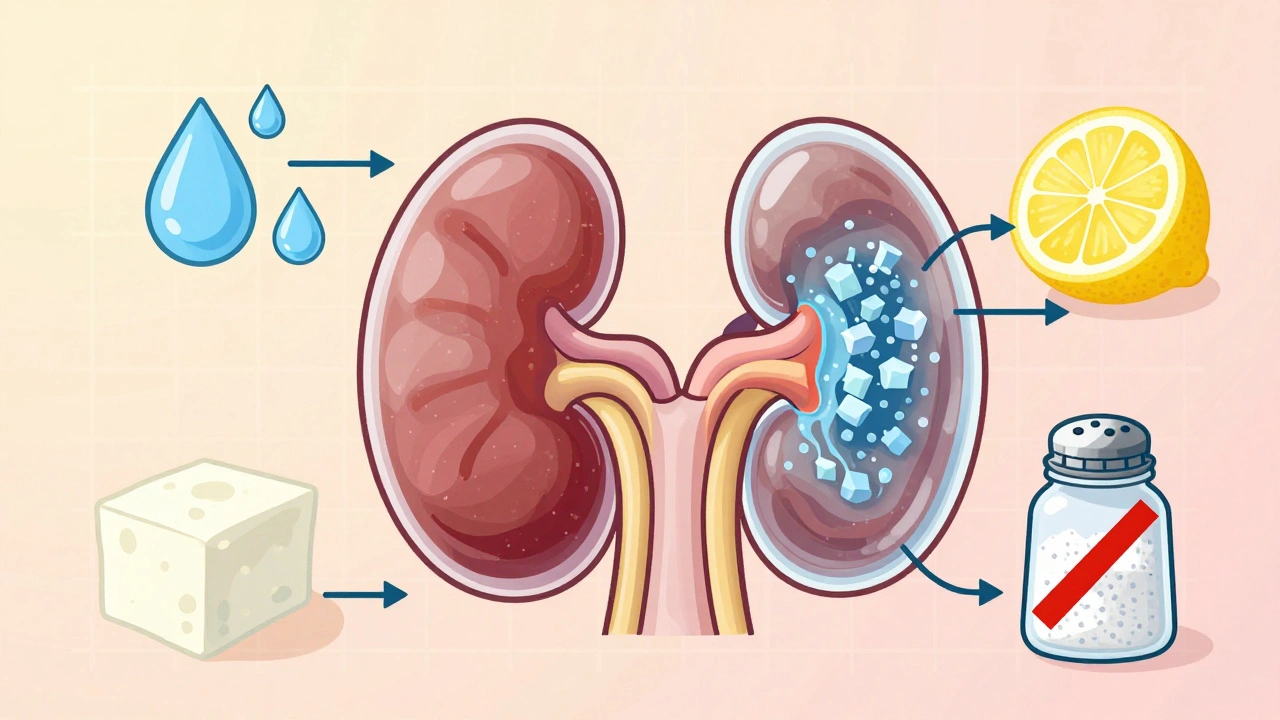
More than half of people who’ve had one kidney stone will get another within five years. Not because they were unlucky. Not because they didn’t drink enough water once. But because kidney stones aren’t a one-time glitch - they’re a chronic metabolic condition. And like diabetes or high blood pressure, they need daily management, not just emergency fixes.
Why Kidney Stones Keep Coming Back
Kidney stones form when minerals in your urine clump together. Most are made of calcium oxalate - about 80% of cases. But the real problem isn’t just oxalate. It’s what’s happening in your body all day, every day. If your urine is too concentrated, too acidic, or too low in citrate, stones will keep forming. And if you don’t fix the underlying pattern, you’re just delaying the next one.
Studies show that without changes, 35% of people get another stone within five years. By ten years, it’s over 50%. That’s not bad luck. That’s a system out of balance. And the good news? You can fix it.
Fluid Intake: The Single Most Important Thing
Forget fancy supplements. Forget miracle teas. The number one thing that stops kidney stones from coming back? Drinking enough water.
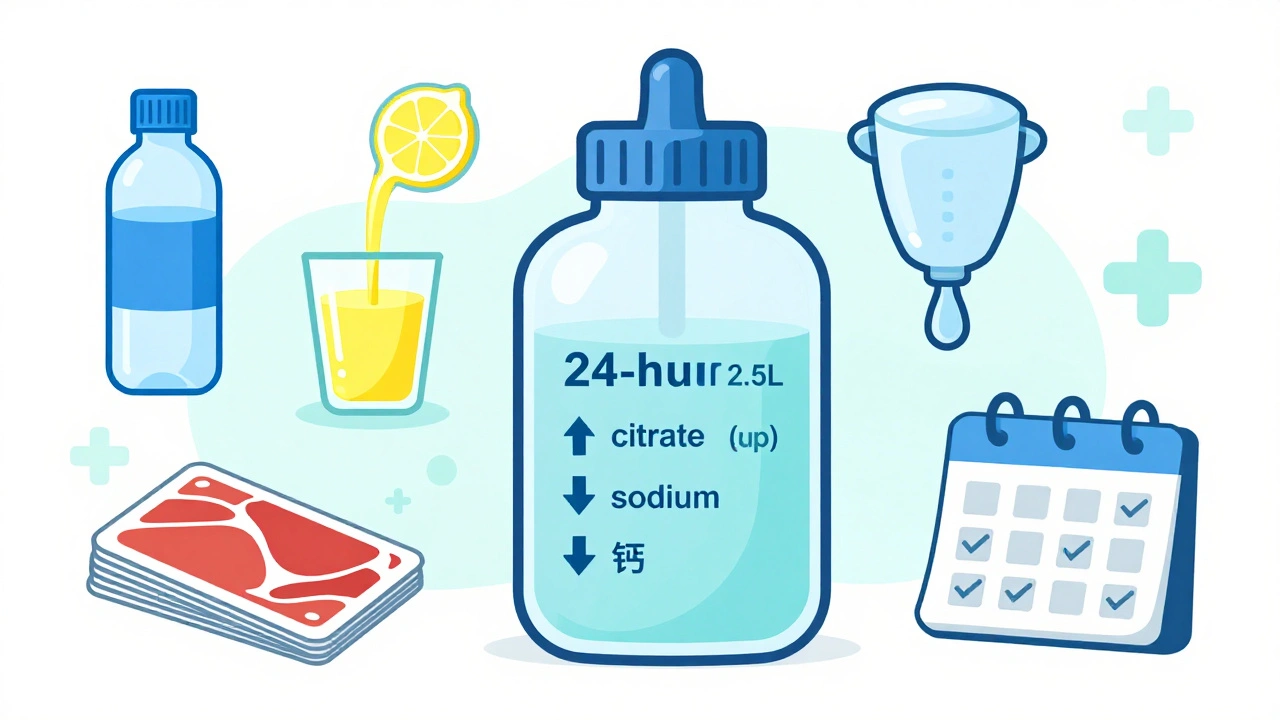
You need to make at least 2.5 liters of urine every day. That means drinking 2.5 to 3 liters of fluid - even more if it’s hot, you’re exercising, or you’re sweating. Most people think they’re drinking enough because they’re not thirsty. But thirst is a late signal. By the time you feel it, your urine is already too concentrated.
Use a marked water bottle. Track it. If you’re not hitting 2.5 liters of urine output daily, you’re not doing enough. Water is best. But tea, coffee, and even lemonade count. The European Association of Urology and the National Kidney Foundation both confirm that caffeine doesn’t dehydrate you enough to matter - as long as you’re getting enough total fluid.
And here’s a simple trick: add fresh lemon juice to your water. Lemon juice is high in citrate, which stops crystals from sticking together. The NHS recommends this, and while it’s not a magic fix, it’s a cheap, easy way to boost your protection. Two tablespoons of lemon juice in a liter of water, once or twice a day, can help.
Don’t Cut Out Calcium - Do the Opposite
For years, doctors told people with kidney stones to avoid dairy. That advice is wrong - and dangerous.
When you eat less calcium, your gut absorbs more oxalate from foods like spinach, nuts, and beets. That oxalate then goes straight into your urine, where it teams up with calcium to form stones. So cutting calcium actually makes stones more likely.
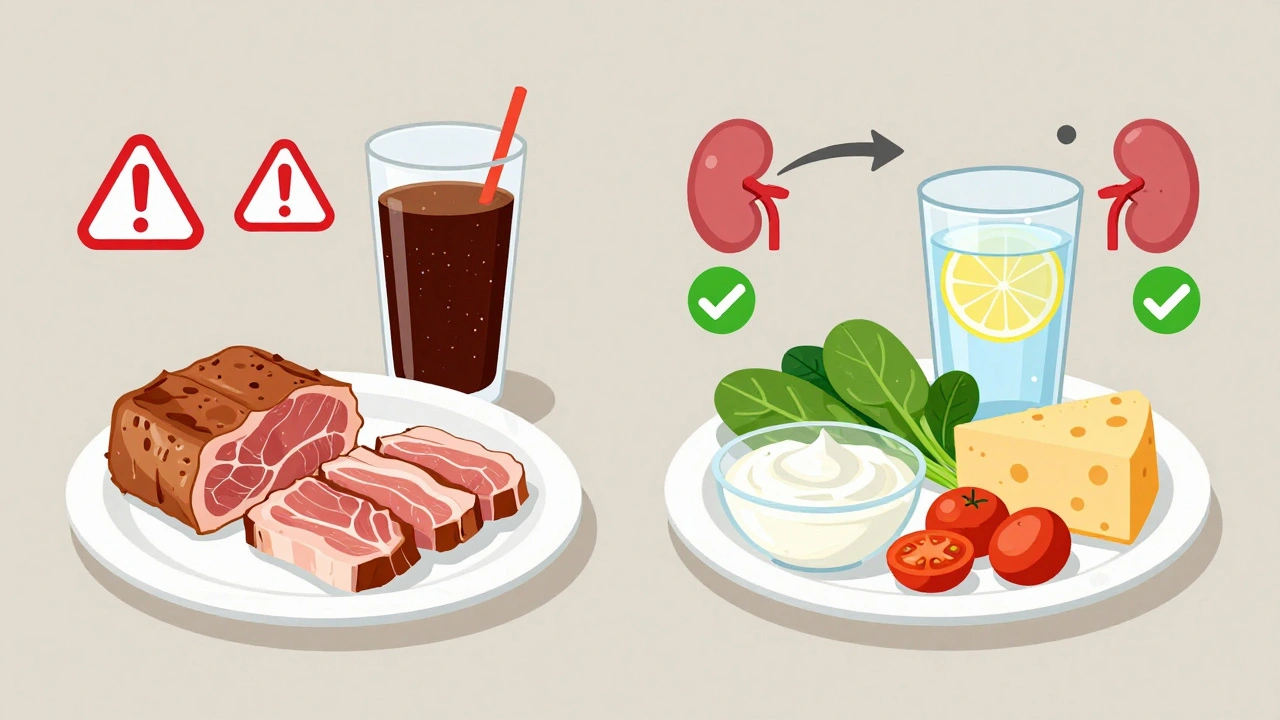
Instead, get your calcium from food. Aim for three servings a day: milk, yogurt, cheese, or calcium-fortified plant milks. Eat calcium-rich foods at the same time as oxalate-rich foods. That way, the calcium and oxalate bind together in your gut and leave your body together - instead of going to your kidneys.
Supplements are different. If you take calcium pills without food, they can increase stone risk. Stick to food sources.
Salt Is the Silent Stone-Maker
High sodium doesn’t just raise blood pressure. It makes your kidneys dump more calcium into your urine. And more calcium in urine = more stones.
You need to limit sodium to 2 grams per day. That’s only 5 grams of salt - less than a teaspoon. But here’s the catch: 75% of sodium comes from processed foods. Bread, canned soup, deli meats, sauces, snacks - they’re all loaded.
Check labels. Cook at home. Rinse canned beans. Skip the soy sauce. Use herbs, lemon, or vinegar for flavor. If you’re eating out, ask for food without added salt. It’s not always possible, but every little reduction helps.
Protein: Less Is More
Animal protein - beef, chicken, pork, fish, eggs - increases uric acid and lowers citrate in urine. Both make stones more likely.
Limit animal protein to about 8 ounces (225 grams) per day. That’s the size of a deck of cards. Not per meal. Per day.
Swap some meat for plant proteins: beans, lentils, tofu, tempeh. People who eat more plant-based foods tend to have fewer stones, according to the National Kidney Foundation. It’s not about going fully vegan. It’s about balance.
Oxalate: Don’t Fear It - Manage It
Spinach, nuts, chocolate, beets, sweet potatoes - these are high in oxalate. But you don’t need to eliminate them. You need to pair them with calcium.
If you eat a spinach salad, have it with cheese or yogurt. If you snack on almonds, drink a glass of milk with them. The calcium binds to oxalate in your gut and stops it from reaching your kidneys.
Also, don’t overdo it. You don’t need to avoid oxalate foods entirely. Just don’t eat huge amounts of them without calcium. And avoid oxalate supplements like vitamin C in high doses - more than 1,000 mg a day can turn into oxalate in your body.
What to Drink - and What to Avoid
Water is your best friend. Lemon water helps. Herbal teas are fine.
But skip the fizzy drinks. Especially colas. They contain phosphoric acid, which lowers citrate and increases stone risk. The NHS specifically warns against them, and for good reason. Even diet sodas aren’t safe - they still have the same harmful acids.
Orange juice can help because it has citrate, but it’s also high in sugar. If you drink it, choose unsweetened, and keep portions small. Lemonade made with real lemon juice and no sugar is better.
Monitoring and Follow-Up
Prevention isn’t a one-time diet. It’s a lifelong habit. And it needs checking.
After you start making changes, your doctor should ask for a 24-hour urine test. This shows if your urine is balanced: enough volume, enough citrate, the right pH, and low sodium and calcium. This test is done after you’ve been eating normally for at least 20 days - so it reflects your real-life habits.
Follow-up tests are recommended 8 to 12 weeks after starting treatment. That’s when you’ll know if your diet and fluids are working. If not, your doctor can adjust - maybe add a medication like potassium citrate, which is proven to help.
And remember: even if you haven’t had a stone in years, keep doing this. The risk doesn’t disappear. It just stays low if you stay consistent.
The Bigger Picture
Kidney stones cost the U.S. healthcare system over $10 billion a year. Most of that is from repeat cases. But prevention works. Studies show that following these dietary steps can cut recurrence risk by 40-50%.
It’s not about perfection. It’s about consistency. Drink enough water. Eat calcium with meals. Cut salt. Limit meat. Skip soda. Do that every day, and you’re not just avoiding pain - you’re protecting your kidneys long-term.
And if you’re one of the 19% of recurrent stone formers who develop chronic kidney disease? You’ll be glad you did.
Can drinking more water really prevent kidney stones from coming back?
Yes - and it’s the most effective step you can take. Making at least 2.5 liters of urine daily cuts recurrence risk significantly. Most people don’t drink enough, even if they feel fine. Use a marked bottle and track your intake. Water, tea, coffee, and lemon water all count. Thirst isn’t a reliable guide - urine color is. Aim for pale yellow.
Should I avoid calcium if I have kidney stones?
No - and avoiding calcium can actually make stones worse. Calcium from food binds to oxalate in your gut and stops it from reaching your kidneys. Eat three servings of calcium-rich foods daily: milk, yogurt, cheese, or fortified plant milks. Take calcium supplements only with meals - never on an empty stomach.
Is it true that lemon juice helps prevent kidney stones?
Yes. Lemon juice is rich in citrate, which stops crystals from forming. Adding two tablespoons of fresh lemon juice to a liter of water once or twice a day can help. It’s not a cure, but it’s a simple, low-cost addition to your daily routine. Avoid bottled lemonade with added sugar - go for fresh.
Do I need to stop eating spinach and nuts?
No. You don’t need to avoid oxalate-rich foods like spinach, nuts, or beets. Just eat them with calcium-rich foods at the same meal. Have spinach with cheese, almonds with yogurt. This helps bind oxalate in your gut so it doesn’t reach your kidneys. Don’t eliminate them - manage them.
Are fizzy drinks really bad for kidney stones?
Yes - especially colas. They contain phosphoric acid, which lowers citrate in urine and increases stone risk. Even diet versions have the same problem. The NHS and other guidelines specifically warn against them. Stick to water, tea, coffee, or lemon water. If you must have soda, choose one without phosphoric acid - but even then, water is better.
How long do I need to follow this diet?
For life. Kidney stone disease is chronic. Even if you haven’t had a stone in five years, your body still has the same metabolic tendency. Stopping your prevention habits means restarting the risk. Think of it like managing blood pressure - you don’t stop after one good reading. You keep going.
Can I still eat meat if I have kidney stones?
Yes - but limit it. Keep animal protein to 8 ounces (225 grams) per day - about the size of a deck of cards. That’s not per meal. That’s for the whole day. Swap some meat for plant proteins like beans, lentils, or tofu. Studies show people who eat more plant-based foods have fewer stones.
Do I need a 24-hour urine test?
Yes, if you’ve had more than one stone. This test shows what’s in your urine - sodium, citrate, calcium, oxalate, and volume. It tells you if your diet is working. Do it 8-12 weeks after making changes. It’s not a one-time thing - repeat it if you’re on medication or if stones come back.
What to Do Next
Start today. Buy a 1-liter water bottle and fill it five times. Write down what you eat for three days - look for hidden salt, too much meat, or oxalate without calcium. Talk to your doctor about a 24-hour urine test. Don’t wait for pain. Prevention isn’t dramatic - it’s daily. And it works.

14 Comments
Emma Sbarge
This is the kind of advice that actually works. No magic pills, no detox teas-just real science. I’ve had three stones in five years and started drinking 3 liters of water daily with lemon. No more stones in 18 months. Simple. Consistent. Effective.
Stop listening to influencers. Start listening to urologists.
Donna Hammond
I can’t tell you how many people I’ve helped with this exact advice. The calcium myth is the biggest barrier-so many avoid dairy out of fear, then wonder why their stones keep coming back. I always say: eat your yogurt with your spinach salad. It’s not complicated. It’s just counterintuitive. And yes, lemon juice in water? Cheap, safe, and clinically proven. Do it every morning. Your kidneys will thank you.
Richard Ayres
It’s fascinating how such a common condition is so poorly understood. The metabolic nature of kidney stones is rarely discussed outside medical circles. Most people treat it like a plumbing issue-clear the blockage and move on. But it’s a systemic imbalance. Like insulin resistance. You don’t fix it with one dose of insulin-you change the entire metabolic environment. That’s what this post nails. The sodium reduction point alone could save millions in healthcare costs.
Sheldon Bird
You got this. Seriously. I used to think I was doing fine because I drank a couple of cups of coffee a day. Then I started tracking my urine output with a marked bottle. Holy crap-I was making less than 1L. Now I’m at 2.8L daily. No stones in 2 years. It’s not sexy. But it works. And yeah, swap that bacon for lentils. Your future self will high-five you.
One step at a time. You’re not failing. You’re learning.
Karen Mccullouch
I’m tired of people acting like this is some new age wellness trend. This isn’t ‘juice cleanses’ or ‘alkaline diets.’ This is MEDICINE. And if you’re still drinking soda because ‘it’s diet,’ you’re just poisoning your kidneys slowly. The NHS says no. The AUA says no. Your urologist says no. Why are you still arguing?
Stop being lazy. Drink water.
Rawlson King
You mention citrate. But you neglect to note that potassium citrate supplementation is often necessary for recurrent stone formers. This dietary advice is incomplete without pharmacological support. Many patients cannot achieve adequate citrate levels through lemon juice alone. Your post is well-intentioned, but dangerously incomplete for high-risk individuals.
Himmat Singh
The assertion that caffeine does not dehydrate is scientifically dubious. While acute diuresis is transient, chronic consumption leads to adaptive changes in renal aquaporin expression, potentially reducing urine volume efficiency over time. Furthermore, the recommendation to consume 2.5–3 liters of fluid daily is not universally applicable. Individuals with reduced glomerular filtration rate may require fluid restriction. This advice, while popular, lacks individualized nuance.
kevin moranga
Let me tell you something-I was skeptical too. I thought, ‘I drink water, I’m fine.’ Then I got stone #4. That’s when I started doing the math. Two liters of water? Nah. Five bottles a day? Yeah. I started carrying one in my car, one at my desk, one in my gym bag. I even set alarms. And guess what? I haven’t had one in over two years. It’s not about being perfect. It’s about being consistent. Some days I drink 4 liters. Some days I drink 2. But I never go below 2.5. That’s the key. And yeah, I eat cheese with my almonds now. It’s weird at first, but your body gets used to it. You got this. One sip at a time.
Alvin Montanez
People think they’re doing enough because they ‘drink water.’ But most of you are still eating processed food, still drinking soda, still eating meat like it’s going out of style. You want to avoid stones? Stop pretending. Stop eating the crap that makes your urine acidic. Stop eating cheese with your chips. Stop thinking ‘moderation’ is enough. If you’re still eating deli meats, you’re not serious. If you’re still drinking diet soda, you’re not serious. If you’re still eating spinach without calcium, you’re not serious. This isn’t a lifestyle tweak. It’s a full system overhaul. And if you’re not ready to go all-in, then stop complaining when you’re back in the ER again.
Keasha Trawick
Okay, but let’s talk about the *biochemistry* for a sec. Citrate chelates calcium, inhibits crystal nucleation, and coats existing crystals to prevent aggregation. Oxalate? It’s a rock-forming anion that binds like glue to calcium in the tubules. And sodium? It’s the silent saboteur-sodium and calcium are cotransported in the nephron, so every gram of salt you eat? That’s a gram of calcium dumped into your urine. This isn’t diet advice-it’s renal physiology in action. And if you’re not doing a 24-hour urine panel, you’re flying blind. No wonder people keep getting stones. They’re treating symptoms, not the underlying metabolic chaos.
Webster Bull
Water. Calcium with meals. Less salt. Less meat. No soda. That’s it. No need to overthink it. Just do it. Every day. Even if you forget one thing, just do the water. That’s the biggest win.
Tommy Watson
I’ve had 7 stones. I tried all this. Didn’t work. Got a stent. Got another stone. Then I found out I had a genetic mutation-hyperoxaluria. This diet stuff? Fine for normal people. But if you’ve got a metabolic disorder, you need meds. Not lemon water. Not yogurt. I’m on potassium citrate, pyridoxine, and a low-oxalate diet. Your post ignores the 15% of us who aren’t just ‘not drinking enough.’ We’re broken. And you’re making us feel guilty for it.
Michael Gardner
Wait, so I can’t have a nice cold cola after working out? That’s it? I’m out. I’m done. I’m going back to my 4 sodas a day. At least I’ll be happy while my kidneys turn to stone. Thanks for the guilt trip.
Willie Onst
I’m from the Midwest. We don’t do ‘lemon water.’ We do iced tea and pop. But I tried it anyway-two tablespoons of lemon in a liter of water every morning. I used to get stones every 9 months. Been stone-free for 3 years now. I still drink tea. I still eat meat. But I eat cheese with my nuts now. Weird? Yeah. But it works. My wife thinks I’m weird. I don’t care. My kidneys are happy. And that’s all that matters.