
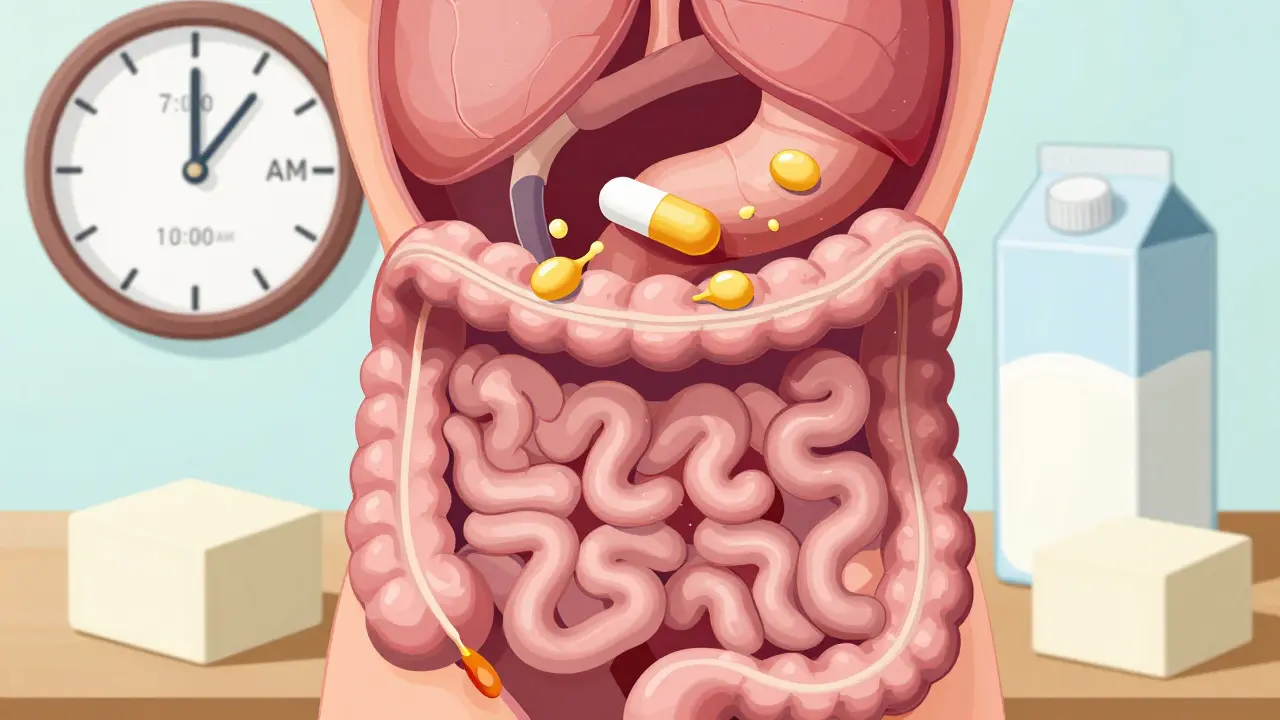
If you're taking levothyroxine for hypothyroidism and you eat soy - whether it's tofu, soy milk, edamame, or a protein shake - you might be unknowingly reducing how well your medication works. It’s not that soy is bad for your thyroid. It’s not. But when it shows up in your gut at the same time as your thyroid pill, it can stick to the medicine and stop your body from absorbing it properly. This isn’t a myth. It’s backed by decades of research, clinical cases, and real patient experiences.
How Soy Interferes with Thyroid Medication
Levothyroxine, the most common thyroid hormone replacement, needs to be absorbed in the upper part of your small intestine. Soy contains proteins and isoflavones - especially genistein and daidzein - that bind to the medication like glue. This binding keeps levothyroxine from being absorbed into your bloodstream. Think of it like pouring water into a cup with a lid on it: the water (your medicine) is there, but it can’t get out.
Studies show this interference can cut absorption by 9% to 30%. That might not sound like much, but for someone who needs precise hormone levels, even a 10% drop can throw off their entire treatment. A 2023 study in the European Thyroid Journal found that when soy milk was consumed just two hours after taking levothyroxine, TSH levels (the hormone that tells your thyroid to work) stayed within normal range. But when soy was eaten within an hour? TSH spiked - sometimes into the hypothyroid range.
It’s not just soy milk. Whole soy foods like tofu, tempeh, and edamame are even more potent because they contain more protein and fiber, which also bind to the drug. Soy protein powders and supplements? Those are the worst offenders. One case report from 2006 described a woman whose levothyroxine dose had to be doubled after she started drinking soy protein shakes daily with her morning pill.
Timing Is Everything
The good news? You don’t have to quit soy. You just need to space it out. The key is timing. Most endocrinologists now agree: separate your medication from soy by at least two hours. But here’s where it gets practical.
Here’s what works for most people:
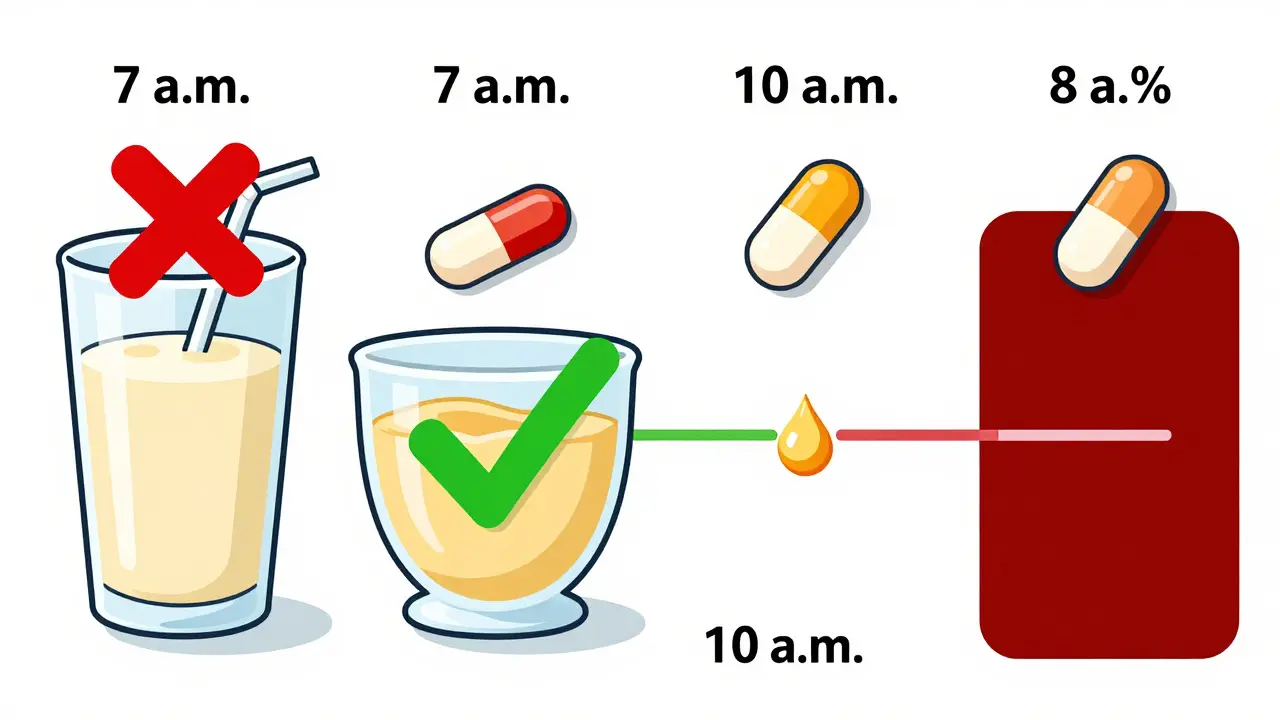
- Morning routine: Take your levothyroxine first thing, with a full glass of water, on an empty stomach. Wait at least 60 minutes before eating anything. Then wait another 2-3 hours before eating soy. That means if you take your pill at 7 a.m., avoid tofu, soy yogurt, or soy milk until after 10 a.m.
- Bedtime option: If mornings are chaotic, many patients do better taking levothyroxine at night, 2-3 hours after their last meal. This avoids breakfast soy entirely. A 2022 survey of endocrinologists found 78% recommended this for patients struggling with morning soy intake.
Why not just wait an hour? Because stomach emptying varies. Some people digest food faster. Others - especially those with gut issues like IBS - take longer. Two hours is the minimum. Three is safer.
How Soy Compares to Other Interferers
Soy isn’t the only food or supplement that messes with levothyroxine. Here’s how it stacks up:
| Substance | Average Absorption Reduction | Recommended Separation Time |
|---|---|---|
| Calcium supplements | 25-36% | 4 hours |
| Iron supplements | 30-40% | 4 hours |
| Soy products | 9-30% | 2-3 hours |
| High-fiber foods (bran, psyllium) | 10-20% | 2-3 hours |
| Coffee | ~20% | 60 minutes |
| Antacids (aluminum/magnesium) | 15-30% | 2 hours |
Notice something? Soy is right up there with coffee and fiber. But unlike calcium and iron - which need a full four-hour gap - soy usually doesn’t require that much. The difference? Soy doesn’t permanently block absorption. It just delays it. Give it enough time, and your body can still get the full dose.
Who’s Most at Risk?
Not everyone is affected the same way. Some people eat soy daily and never have an issue. Others see their TSH jump within weeks. Why?
- Infants and children: Soy formula can increase levothyroxine needs by 15-30%. Pediatric endocrinologists always check for soy intake.
- People with subclinical hypothyroidism: If your TSH is already above 4.5 mIU/L, soy can push it higher. A 2019 meta-analysis of 3,600 people found soy only raised TSH in this group.
- Vegetarians and vegans: They’re more likely to consume soy daily. One 2022 survey found 74% of plant-based patients with hypothyroidism had been advised by their doctor to adjust timing.
- People on inconsistent schedules: If you take your pill at 7 a.m. one day and 10 a.m. the next, soy timing gets messy. Consistency matters more than you think.
And here’s a twist: some people never have a problem. Reddit threads are full of comments like, “I’ve had Synthroid with soy milk for 10 years. My TSH is perfect.” Why? Genetics. Gut health. Dose size. Even iodine intake. If you’re iodine-replete (which most people in Australia are), your thyroid is more resilient. But if you’re borderline, even small interference adds up.
What to Do If You Suspect a Problem
Signs your soy intake might be messing with your meds:
- Your TSH suddenly climbs (e.g., from 1.8 to 5.2)
- You feel more tired, cold, or foggy - even though your dose hasn’t changed
- You started eating more soy around the same time your symptoms got worse
Here’s what to do:
- Track your soy intake. Write down everything you eat with soy for a week.
- Change your timing. Try taking levothyroxine at bedtime, 2 hours after dinner. Avoid soy entirely for 3 weeks.
- Get a TSH test. After 4-6 weeks, ask your doctor for a repeat test.
- If TSH normalizes, you’ve found your culprit. Go back to your old routine - but now you know to separate soy by 3 hours.
Don’t adjust your dose on your own. Too much levothyroxine can cause bone loss, heart rhythm issues, or anxiety. Let your doctor handle the numbers.
Practical Tips for Daily Life
Here’s how real people make this work:
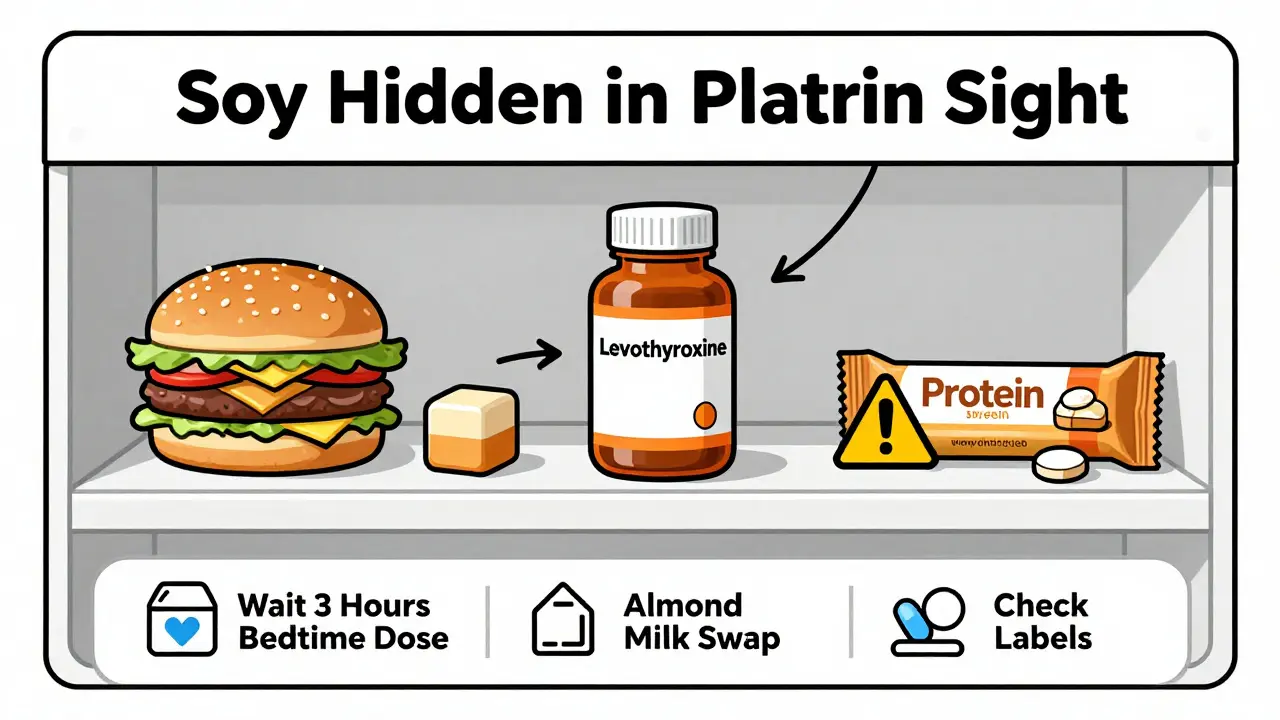
- Breakfast swap: Swap soy milk for almond, oat, or rice milk in the morning. They don’t interfere.
- Lunch and dinner are safe: Tofu stir-fry at 6 p.m.? Fine. Just make sure your pill was taken at least 3 hours earlier.
- Protein shakes: If you use soy protein, take it at lunch or after dinner - never with your pill.
- Travel tip: Pack your levothyroxine in your carry-on. Take it as soon as you wake up, before breakfast, even on planes.
- Label check: Soy hides in broths, sauces, veggie burgers, and even some vitamins. Read ingredients.
One patient I know, a 52-year-old teacher from Perth, switched from soy yogurt to coconut yogurt and saw her TSH drop from 5.1 to 1.9 in 8 weeks. She didn’t change her dose. She just changed her routine.
What About Soy Supplements?
Isolated soy isoflavone pills? They’re less likely to interfere than whole soy foods - but still risky. A 2015 report from the European Food Safety Authority said they don’t affect thyroid function in healthy women. But for someone on levothyroxine? The data isn’t clear. Better safe than sorry: take them at least 2 hours after your pill. Or skip them. There’s no proven benefit for thyroid patients.
Final Takeaway
You don’t need to give up soy. You need to manage it. The science is clear: timing matters more than avoidance. Take your levothyroxine on an empty stomach. Wait an hour before eating. Wait two to three hours before eating soy. Stick to it. Test your TSH every 6-8 weeks after any change. And if your doctor hasn’t mentioned this - bring it up. Many still don’t.
Thyroid medication isn’t just about the pill. It’s about your whole day - what you eat, when you eat it, and how your body handles it. Soy isn’t the enemy. Ignorance is.
Can I eat soy if I take levothyroxine at bedtime?
Yes - as long as you wait at least 2 hours after your last meal before taking your pill. If you eat soy for dinner, wait until after midnight to take your medication. Avoid eating soy within 2 hours of your dose, whether it’s morning or night.
Does cooking soy reduce its interference?
No. Boiling, steaming, or fermenting soy doesn’t remove the isoflavones or proteins that bind to levothyroxine. Tofu, tempeh, and soy milk - even if cooked - still interfere. Only timing helps.
I take levothyroxine and eat soy daily. My TSH is normal. Do I need to change anything?
If your TSH has been stable for over a year and you feel fine, you may not need to change. But don’t assume you’re immune. Some people have delayed reactions. Ask your doctor to check your TSH and free T4 levels - just to be sure. Also, consider if your diet has changed recently. A small shift in soy intake can cause a slow drift in hormone levels.
Is soy harmful to people without thyroid problems?
No. In people with normal thyroid function and enough iodine, soy does not cause hypothyroidism. Multiple studies, including one from the European Food Safety Authority, confirm this. The risk is only for those taking thyroid medication or with pre-existing thyroid issues.
Can I take levothyroxine with water and then drink soy milk 30 minutes later?
No. Thirty minutes is too soon. Even if you wait 60 minutes to eat, soy still interferes. Studies show absorption drops significantly if soy is consumed within 2 hours. Wait at least 2-3 hours after taking your pill before drinking soy milk or eating any soy product.
13 Comments
Shruti Chaturvedi
I've been on levothyroxine for 8 years and eat soy daily. My TSH is perfect. I take it at 7 a.m. and have soy yogurt at 10:30. No issues. Maybe it's genetics or iodine levels. Don't scare people into cutting out whole foods without proof.
Also, why is this even a thing? Soy isn't evil. It's protein. We're not talking about grapefruit here.
Devin Ersoy
Oh honey. You're telling me that the same isoflavones that give me estrogenic benefits and reduce breast cancer risk are now the villain because they 'stick to your pill like glue'? Please. I've seen endocrinologists who still think gluten is a demon. This is just modern medicine's version of witch hunts wrapped in a 2023 journal article.
Meanwhile, I'm sipping my soy latte at 7:15 a.m. and my TSH is 1.2. If your body can't handle a little genistein, maybe your gut is the problem - not the soy.
Scott Smith
The science is clear: spacing matters. I'm not here to demonize soy. But if you're a vegan with subclinical hypothyroidism and you're taking your pill with your oat-soy smoothie, you're playing Russian roulette with your metabolism. This isn't theory - it's clinical fact. I've seen patients go from 2.1 to 7.8 TSH because they thought 'it's just soy.'
Don't be the person who says 'I'm fine' and then shows up in the ER with a TSH of 15.
Emma Deasy
I must express my profound concern regarding the casual dismissal of pharmacokinetic interference in this context. The notion that 'some people are fine' is not only scientifically unsound - it is dangerously irresponsible. Levothyroxine has a narrow therapeutic index. A 9% reduction in bioavailability is not a footnote - it is a clinically significant deviation that can precipitate overt hypothyroidism, particularly in vulnerable populations such as the elderly, pregnant individuals, and those with concomitant renal impairment.
Furthermore, the suggestion that 'timing is everything' without emphasizing the variability in gastric emptying times across individuals is a disservice to patient safety. One must consider comorbidities, concomitant medications, and microbiome diversity. This is not a one-size-fits-all recommendation.
tamilan Nadar
In India, we’ve been eating soy with thyroid meds for decades. No one talks about this. My aunt took her pill at 6 a.m., had soy dal for breakfast, and lived to 87. Maybe it’s because we eat with rice and spices? Or maybe the dose is different? I think Western medicine overcomplicates everything.
Adam M
If your TSH is stable, you’re fine. If it’s not, stop eating soy. Done.
Rosemary Chude-Sokei
Thank you for this thorough, evidence-based breakdown. As someone who manages hypothyroidism and follows a plant-based diet, I’ve been confused for years. The fact that soy interferes less than calcium or iron is eye-opening. I’ve switched to almond milk in the morning and take my pill at bedtime. My TSH has been rock solid for 14 months now. This is the kind of clarity we need - not fear, but practical, personalized strategy.
Noluthando Devour Mamabolo
As a clinical nutritionist in Cape Town, I’ve seen this pattern repeatedly. Soy is not the enemy - inconsistency is. The real issue? Patients take their medication with coffee, then eat tofu for breakfast, then take calcium at lunch, then have fiber supplements at dinner. It’s a pharmacokinetic perfect storm.
My protocol: 1) Pill on empty stomach, 2) Wait 60 min, 3) Avoid all binders (soy, fiber, calcium, iron) for 2–3 hrs, 4) Re-test TSH at 6 weeks. Simple. Effective. Underutilized.
Leah Dobbin
I find it fascinating how the medical community has suddenly decided soy is dangerous. Meanwhile, glyphosate-laden soybean crops are being pumped into every processed food in America. Are we blaming the messenger? The real issue is industrial agriculture and the systemic erosion of nutrient density in our food supply - not tofu.
Ali Hughey
This is all a Big Pharma scheme. Levothyroxine is a billion-dollar drug. If people just stopped eating soy, they’d have to lower doses - and then insurance companies would stop paying for it. They want you scared. They want you buying almond milk. They want you buying more lab tests. They want you dependent. Wake up. The thyroid is a natural organ. It doesn’t need synthetic hormones to function if you just eat real food - and avoid the soy-industrial complex.
P.S. I’ve been off levothyroxine for 3 years. I eat soy daily. My TSH is 1.5. Coincidence? I think not.
Alex MC
I’ve been on Synthroid for 12 years. I eat edamame for lunch. I take my pill at 6 a.m. I’ve never had a problem. I’m not saying this doesn’t happen - I’m just saying it doesn’t happen to everyone. Maybe your body handles it differently. I’d rather see individualized testing than blanket recommendations. One size doesn’t fit all - especially not with hormones.
rakesh sabharwal
You're overcomplicating this. Soy is a phytoestrogen. Phytoestrogens are endocrine disruptors. Endocrine disruptors = bad. You're just giving your thyroid a harder time. Why not just avoid it? You're not saving the planet by eating tofu. You're just making your medication less effective. Simple.
Aaron Leib
This is exactly the kind of practical, science-backed advice we need. I coach patients on thyroid health daily. The timing advice - especially the bedtime option - is a game-changer. Many people think they have to choose between their health and their values. They don’t. You can be vegan and well-managed. It’s about rhythm, not restriction. I’ve seen patients transform with just a 2-hour gap. It’s not magic. It’s pharmacology.