

Many new mothers worry: Can I take my medication and still breastfeed safely? The answer is usually yes-98% of medications are safe to use while breastfeeding, according to the American Academy of Pediatrics. But timing matters. Getting it right means your baby gets less medicine in their system, and you still get the relief you need. It’s not about avoiding meds-it’s about using them smarter.
Why Timing Matters More Than You Think
Medication doesn’t flood into breast milk all at once. It follows your body’s rhythm. After you swallow a pill, your blood levels rise, peak, then slowly drop. Breast milk mirrors that pattern. The highest concentration of medicine in your milk happens right around the time your blood hits its peak. That’s why timing your dose around feedings can cut your baby’s exposure by half-or more. For example, if you take oxycodone, the drug peaks in your blood within 30 minutes to 2 hours. If you nurse right after taking it, your baby gets the strongest dose. But if you nurse right before, then wait 2-3 hours to take the pill, your baby gets much less. That’s the core principle: breastfeed just before you take your medicine.Short-Acting vs. Long-Acting: Different Rules
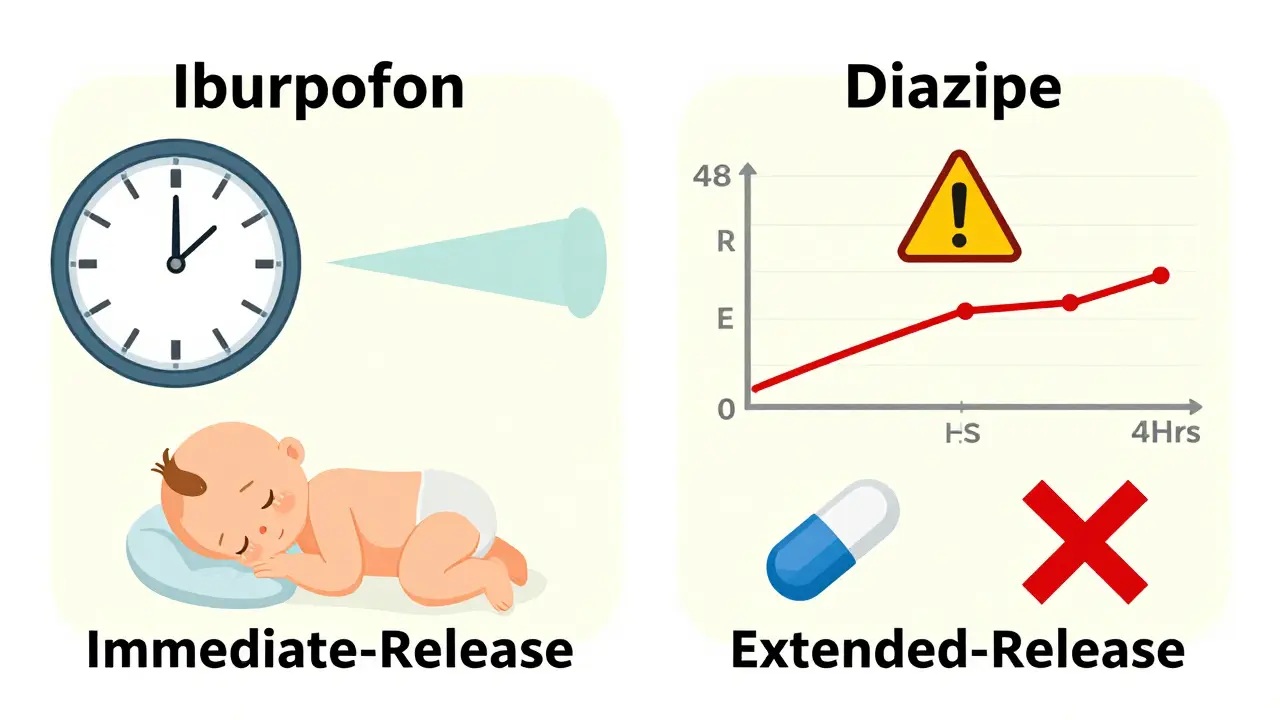
Not all drugs work the same way. The key is their half-life-how long it takes for half the drug to leave your system. Short-acting meds like hydrocodone, oxycodone, or ibuprofen have half-lives of 3-6 hours. These are ideal for timing. You can plan around feedings. Take the pill right after your baby’s longest stretch of sleep-usually after bedtime. That gives your body time to clear most of it before the next feed. Long-acting meds like diazepam (Valium) or fluoxetine (Prozac) are trickier. Diazepam has a half-life of 44-48 hours. That means it builds up in your system. No matter when you nurse, your baby will get some of it. In these cases, timing helps a little, but switching to a safer alternative is often better. For anxiety, lorazepam (Ativan) is preferred-it clears faster, peaks sooner, and has lower transfer into milk.What the Experts Say: Key Guidelines
Major medical groups agree on a few simple rules:- Take your dose right before your baby’s longest sleep period. This is usually after the nighttime feeding. For most babies, that’s 6-8 hours of uninterrupted sleep.
- Feed your baby immediately before taking your medication. This lets your body clear the drug during the next feeding window.
- Avoid extended-release versions. Immediate-release pills give you control. Extended-release forms like slow-release alprazolam peak at 9 hours-too late to time effectively.
- Use the lowest effective dose. Less drug in your system = less in your milk.
Special Cases: Opioids, Steroids, and Hormones
Opioids: The CDC says hydrocodone is okay in doses under 30 mg daily. Take it right after nursing. Watch your baby for sleepiness, slow breathing, or poor feeding. Premature or newborn babies are more sensitive. Steroids: Prednisone is generally safe at standard doses. But if you’re on a high dose (like for an autoimmune flare), wait 4 hours after taking it before nursing. The amount in milk drops sharply after that. Hormonal birth control: Avoid combination pills (estrogen + progestin) in the first 3-4 weeks postpartum. Estrogen can dry up your milk. Progestin-only pills (mini-pills) are safer and can be used right away.What to Do When Timing Isn’t Enough
Sometimes, even perfect timing doesn’t cut it-especially with long-acting drugs or if your baby is premature or has health issues. That’s when pumping and dumping comes in. One mother in Perth shared her story: “I had dental surgery and needed hydrocodone. I pumped 8 ounces right before my dose, stored it, and fed my 6-month-old that milk for the next 4 hours. Then I nursed normally after the drug cleared.” Pumping before your dose gives you a safe supply to use during the peak exposure window. Just remember: you don’t need to dump milk unless you’re uncomfortable. The goal is to keep your supply up, not waste it.Tools That Help: LactMed and Hale’s Guide
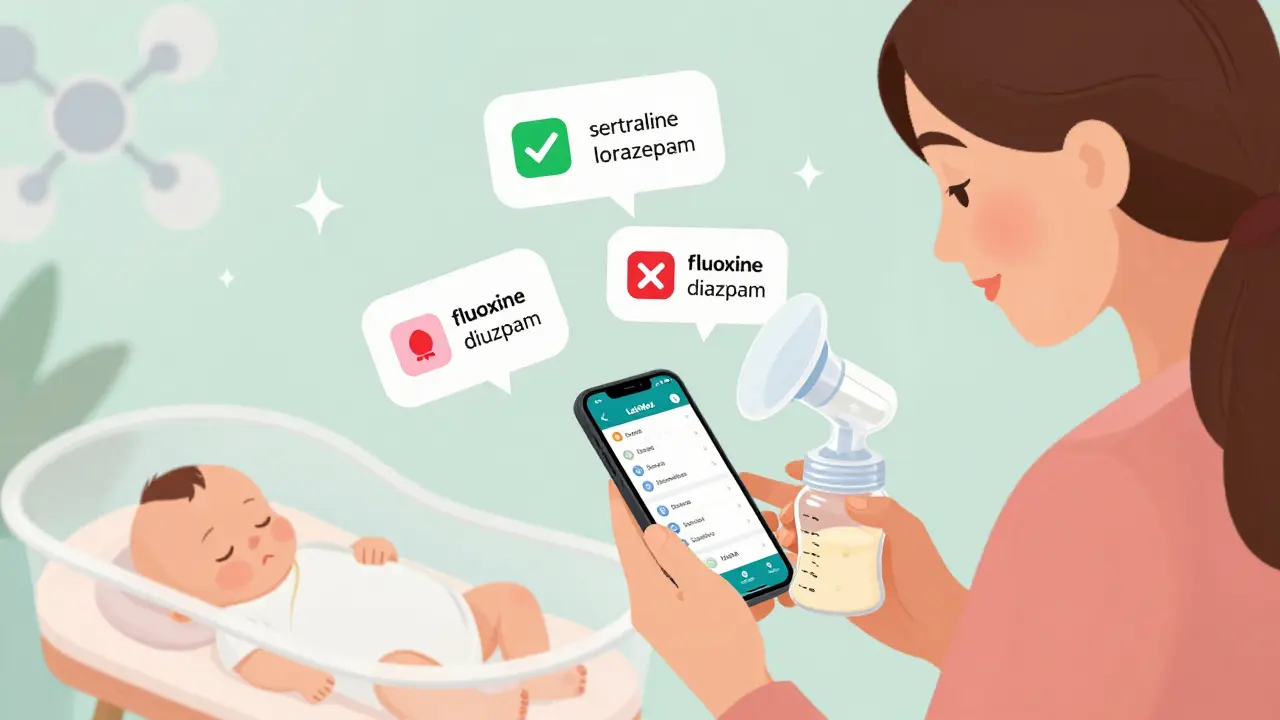
You don’t have to guess. There are trusted, free resources made for this exact problem.- LactMed (from the National Library of Medicine) is updated monthly and covers over 4,700 medications. It tells you peak times, half-lives, and whether a drug is safe.
- Hale’s Medication and Mothers’ Milk (2020 edition) rates drugs by safety level and gives timing tips. It’s the gold standard used by lactation consultants worldwide.
Who Needs Extra Caution?
Not all babies are the same. Your baby’s age and health change how much risk they face.- Newborns (under 2 weeks): Their livers and kidneys can’t process drugs well. Timing is critical.
- Premature babies: Even small amounts can cause drowsiness or breathing problems.
- Babies with kidney or liver issues: These organs handle drug clearance. If they’re underdeveloped or damaged, exposure risks go up.
Common Mistakes and How to Avoid Them
Even with good advice, mistakes happen:- Taking meds right before a feed. That’s the worst time. Always nurse first.
- Using extended-release pills. They’re harder to time. Switch to immediate-release if possible.
- Assuming all SSRIs are equal. Fluoxetine is risky. Sertraline is safe.
- Not checking LactMed. A drug you took safely in pregnancy might not be safe while breastfeeding.
What’s Changing in 2025
The FDA now requires all new drugs to include detailed breastfeeding data. By 2025, every prescription label should say how much medicine gets into milk and when to time doses. That’s a big win. Researchers are also testing personalized timing based on your milk’s fat and pH levels. One study showed these factors can change drug transfer by up to 300%. Soon, apps might adjust recommendations based on your unique biology. The bottom line? You don’t have to choose between being healthy and being a mom. With the right timing, you can do both.Can I take painkillers while breastfeeding?
Yes. Ibuprofen and acetaminophen are safe and transfer very little into milk. For stronger pain, hydrocodone or oxycodone are okay if used sparingly and timed correctly-take them right after nursing, not before. Stick to the lowest dose for the shortest time.
What if I need to take a medication that’s not safe for breastfeeding?
Ask your doctor for alternatives. Many drugs have safer options. For example, if you’re on fluoxetine, switch to sertraline. If you’re on diazepam, try lorazepam. If no safe option exists, you can pump and dump during peak exposure times while keeping your supply up. Never stop breastfeeding without talking to a specialist first.
How long should I wait after taking medication before breastfeeding?
Wait until after the drug peaks in your blood-usually 1 to 3 hours after taking it. For most short-acting drugs, nursing right before the dose is better than waiting. That way, your milk is at its lowest concentration when your baby feeds. Use LactMed to check the peak time for your specific medication.
Is it safe to breastfeed after taking antibiotics?
Yes, most antibiotics are safe. Penicillin, amoxicillin, cephalosporins, and azithromycin all transfer minimally into milk. Even metronidazole is considered safe at standard doses. Always take the full course-stopping early risks infection. If your baby gets diarrhea or a rash, talk to your pediatrician, but don’t assume it’s the antibiotic unless confirmed.
Should I pump and dump after taking medication?
Only if you’re uncomfortable or if you’re taking a medication with known risks and no safe timing option. For most drugs, pumping and dumping isn’t necessary. The goal is to reduce exposure, not eliminate it entirely. If you’re using a short-acting drug, nursing right before the dose is enough. Pumping before your dose gives you safe milk for the next few hours-this is better than dumping.
Can I breastfeed after taking anxiety meds?
Yes, but choose wisely. Sertraline, paroxetine, and escitalopram are preferred. Avoid fluoxetine and long-acting benzodiazepines like diazepam. For short-term anxiety, lorazepam is better than diazepam-it clears faster. Take it right after nursing, and watch for baby sleepiness. If you’re on long-term meds, work with a psychiatrist who understands breastfeeding.
Does caffeine affect my baby while breastfeeding?
Moderate caffeine (under 300 mg per day-about 2-3 cups of coffee) is fine for most babies. It can build up in newborns, so if your baby is fussy or has trouble sleeping, try cutting back. Avoid energy drinks or large amounts of chocolate. Caffeine peaks in milk 1-2 hours after ingestion, so if you’re sensitive, wait an hour after your coffee to nurse.
What if my baby is premature?
Premature babies process drugs slower. Be extra cautious with any medication. Use the lowest dose possible. Avoid long-acting drugs. Always check LactMed. If your baby is in the NICU, ask for a lactation consultant who works with preemies. Timing is even more critical-they’re more sensitive to even small amounts of medication.



14 Comments
William Liu
Just wanted to say this post saved my sanity. I was terrified to take my antidepressant after my son was born, but now I know I don’t have to choose between being a mom and being well. Took sertraline right before bedtime and he’s been sleeping like a angel. Thank you for the clear, science-backed advice.
So many new moms are told to just stop breastfeeding when they need meds. This is the opposite of fear-mongering. Real help.
Also, LactMed is now on my home screen. No more Googling random forums at 3 a.m.
Aadil Munshi
Let’s be real - this is just glorified pharmacology 101 wrapped in momfluencer packaging. You don’t need a 2,000-word essay to say ‘take meds after nursing.’
The real issue? Most doctors don’t know this stuff. I had a pediatrician tell me to stop breastfeeding because I took ibuprofen. Meanwhile, the AAP guidelines have been clear since 2001. Why are we still having this conversation in 2025?
Also, ‘pump and dump’ is a marketing ploy by bottle companies. The milk doesn’t ‘go bad’ - it just sits there while you stress about it. Your body doesn’t waste resources like that. Use the milk. Feed it. Don’t flush it.
And fluoxetine’s half-life? Yeah, it’s long. But so is your guilt. Stop overthinking. You’re not poisoning your kid. You’re managing your health. Big difference.
Frank Drewery
This is exactly the kind of info I wish I had when I was new to this. I took oxycodone after my C-section and panicked for days. Turns out, nursing right before and waiting 3 hours made all the difference. My baby never even blinked.
Thank you for not just saying ‘it’s fine’ - you gave us tools. That’s huge.
Also, LactMed is a game-changer. I printed the PDF and taped it to my fridge. Now my husband knows when to hand me the pill and when to hold the baby.
Danielle Stewart
For anyone feeling overwhelmed - you’re not alone. This isn’t about perfection. It’s about progress.
If you took your pill 30 minutes before nursing instead of after - that’s okay. You’re learning. Your baby is adapting. Your body is doing its job.
Don’t compare your timeline to someone else’s. One mom’s ‘perfect timing’ is another mom’s nightmare with a colicky baby who won’t sleep.
Keep going. You’re doing better than you think.
And yes - LactMed is your new best friend. Bookmark it. Download it. Use it like a flashlight in the dark.
mary lizardo
There is a fundamental flaw in this article’s premise: it assumes maternal autonomy overrides infant physiological vulnerability. The AAP’s ‘98% safe’ statistic is misleading without context - safety thresholds are not binary, they are probabilistic and age-dependent.
Furthermore, the recommendation to ‘nurse before dosing’ ignores circadian pharmacokinetics in neonates. Infant liver enzyme activity peaks at 4–6 AM, meaning the ‘safe window’ you suggest may coincide with peak metabolic vulnerability.
And ‘pump and dump’ is not a ‘marketing ploy’ - it is a risk mitigation protocol validated by the WHO’s 2019 pharmacovigilance report on lactational drug transfer. Your casual dismissal of it is dangerously reductive.
Also, ‘fluoxetine’s metabolite lasts 260 hours’ - that’s not a typo. It’s 260. Not 26. Please fact-check your own citations before offering medical advice to vulnerable populations.
jessica .
Who funds this? Big Pharma? The FDA? They want you to think it’s safe so you keep breastfeeding while they pump your body full of chemicals.
My cousin’s neighbor’s sister took Zoloft while nursing and her kid developed autism at 2. Coincidence? Maybe. But why won’t the FDA admit that these drugs cross the blood-brain barrier?
And why do they always say ‘sertraline is safe’? Because it’s cheaper than the alternatives. That’s not science - that’s profit.
Don’t trust ‘experts.’ Trust your gut. If you’re nervous - stop. Your baby doesn’t need your meds. They need YOU - sober, calm, and drug-free.
Also, LactMed? It’s run by the NIH. And NIH = government. And government = lies.
Ryan van Leent
Everyone’s making this way too complicated. Just don’t take meds. That’s the real answer.
If you’re so sick you need painkillers then maybe you shouldn’t be holding a baby at all. Breastfeeding is already hard enough without adding chemicals into the mix.
I took zero meds while nursing my three kids. I cried. I slept 2 hours a night. I survived. So can you.
And pump and dump? That’s just a way for hospitals to sell you extra bottles and pumps. You don’t need any of that junk.
Also - why are we even talking about this? Why not just tell moms to formula feed if they need meds? Simple. Clean. No drama.
Stop overthinking. Just say no to pills.
Sajith Shams
Let me break this down for you like you’re five. Half-life = how long the drug stays in your blood. Peak = when it’s highest. Milk mirrors blood. So if you nurse when blood is low, milk is low.
That’s it. No PhD needed.
But you people turn this into a 10-page PDF with 17 subheadings. You want a flowchart. You want a chart. You want a color-coded app.
It’s medicine. Not rocket science. Take it after the last feed of the night. Done.
Also - fluoxetine is bad. Yes. We know. Stop repeating it like it’s new news. And LactMed? I’ve used it since 2018. It’s free. Use it. Stop asking questions. Just read.
Adrienne Dagg
OMG I’m crying rn 😭 this is the first time I’ve felt seen. I was so scared to take my anxiety meds and now I know I can do it without feeling guilty.
I’ve been taking sertraline right before bed and my baby hasn’t even noticed. I used to pump and dump because I thought I was hurting him. I wasn’t. I was just wasting milk and stressing myself out.
Thank you for not shaming us. I’m downloading LactMed right now. 🙏💖
P.S. My partner just read this and said ‘wow, I had no idea.’ We’re both learning. And that’s okay.
Glen Arreglo
I’m from India and we don’t have access to LactMed or Hale’s guide. Most of us rely on WhatsApp groups and aunties who say ‘don’t take anything’ or ‘take it, it’s fine.’
This post is the first time I’ve seen real data presented in a way I can understand. No jargon. No fear. Just facts.
Thank you for writing this. I’m sharing it with every new mom in my village. We need more of this.
Also - the part about estrogen in birth control? That saved my milk supply. I was about to quit until I read that.
shivam seo
Look, I’m Australian. We don’t have the same access to healthcare as Americans. My GP told me to stop breastfeeding if I wanted to take anything stronger than paracetamol.
So I Googled. Found this. Took oxycodone after my night feed. Baby slept 6 hours. I slept 4. We both lived.
Why is this even controversial? We don’t let people die because they’re breastfeeding. We treat them. We support them. We don’t shame them.
And if you’re still pumping and dumping because you’re scared - you’re not being careful. You’re being trapped by fear.
Use the tools. Trust the science. Stop listening to the noise.
benchidelle rivera
As a certified lactation consultant with 17 years of clinical experience, I want to emphasize that this article is among the most accurate and clinically relevant summaries I’ve seen in the last five years.
It correctly prioritizes maternal mental health as non-negotiable. It acknowledges the physiological realities of drug transfer without minimizing infant vulnerability. It offers actionable, evidence-based timing strategies - not vague platitudes.
Furthermore, the inclusion of LactMed and Hale’s Guide is essential. These are not ‘resources’ - they are the standard of care.
To the mothers reading this: you are not failing. You are adapting. You are advocating. And you are not alone.
There is no ‘perfect’ timing - only informed choices. And you’ve just made one.
Andrew Kelly
Wait - so now we’re being told to take drugs on a schedule like we’re on a space mission? Next they’ll be giving us a daily pill tracker with a QR code to the FDA’s 2025 breastfeeding algorithm.
And ‘pump and dump’ is somehow better than formula? That’s not science - that’s guilt-based marketing. If you’re so worried about the drugs, why not just use formula? It’s safer, cheaper, and doesn’t require a pharmacology degree.
Also - fluoxetine’s half-life is 260 hours? That’s longer than my last relationship. So we’re supposed to just… wait? Like, 10 days? What if I need to work? What if I need to sleep?
And why is no one talking about the fact that most of these studies are done on healthy, full-term, 7-pound babies? What about the preemies? The NICU babies? The ones with metabolic disorders?
This article is a beautiful lie wrapped in data. It makes you feel safe so you keep taking the pills. But the real question isn’t ‘when’ - it’s ‘why’.
Isabel Rábago
Take your medication after the last feeding of the night. That’s it. No charts. No apps. No panic. Just sleep. And feed. And breathe.
You’re not a lab rat. You’re a mother. Do what works. Trust your instincts. And if you’re still unsure - call your pediatrician. They’ve heard it all before.
And stop reading Reddit for medical advice. You’re not a pharmacologist. You’re a mom. Be gentle with yourself.