
Every morning, you put on moisturizer. Maybe you skip it when you’re in a rush. But do you skip sunscreen? If you do, you’re not alone - but you’re also putting your skin at risk, even on cloudy days or when you’re just running to the car. Sun damage isn’t just about sunburns. It’s about invisible harm that builds up over years, leading to wrinkles, dark spots, and even skin cancer. The truth is, you don’t need to be at the beach to need sunscreen. You need it every single day.
What SPF Really Means - And What It Doesn’t
SPF stands for Sun Protection Factor. It’s a number you see on every bottle, but most people don’t know what it actually means. SPF measures protection against UVB rays - the ones that cause sunburn. An SPF 30 sunscreen doesn’t mean you can stay in the sun 30 times longer without burning. It means it takes 30 times longer for your skin to redden if you apply the right amount.
Here’s the math: SPF 15 blocks about 93% of UVB rays. SPF 30 blocks 97%. SPF 50 blocks 98%. That’s it. The jump from SPF 30 to 50 only gives you 1% more protection. But here’s the catch: almost no one applies enough. Studies show people use only 25% to 50% of the recommended amount. That means if you slap on SPF 50 but use half as much as you should, your real protection drops to SPF 15 or even lower. That’s why dermatologists say SPF 30 is the sweet spot - it’s strong enough, and most people can actually use enough of it to make it effective.
UVA vs. UVB: The Silent vs. The Burning
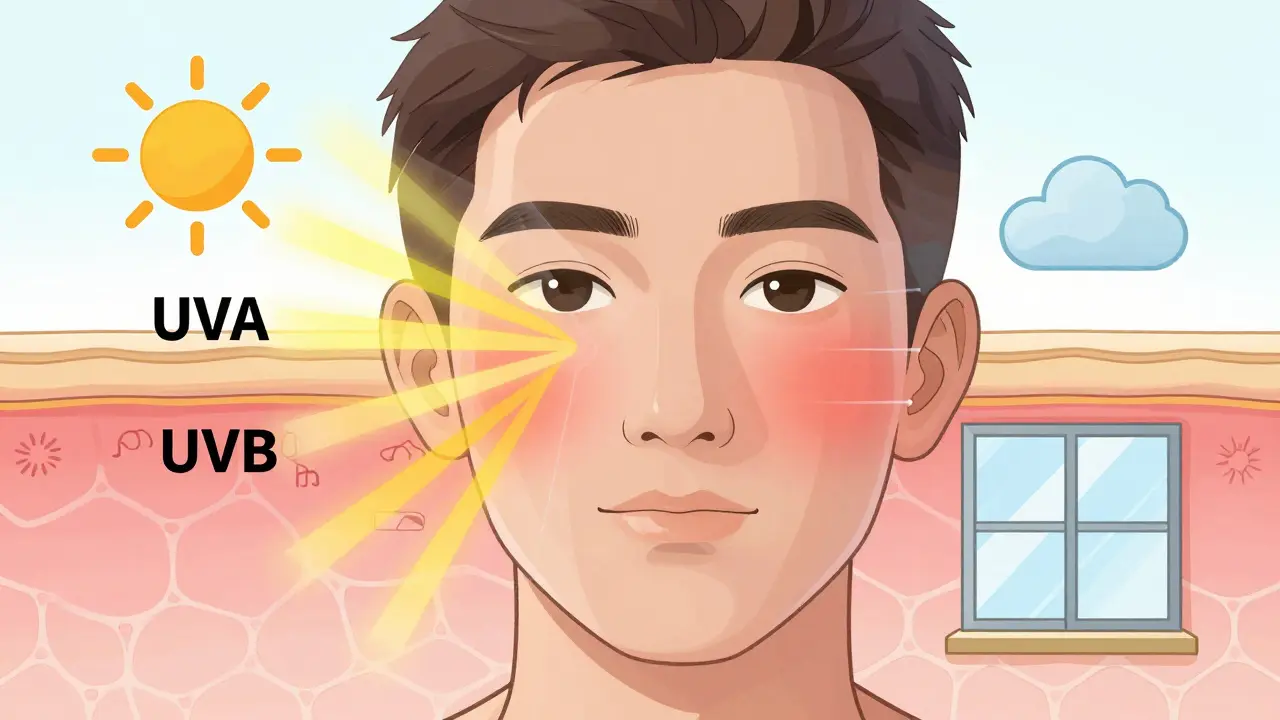
Not all UV rays are the same. UVB rays are the short-wavelength offenders. They hit the top layer of your skin, cause sunburns, and directly damage DNA. That’s why they’re linked to melanoma and other skin cancers. But UVA rays? They’re sneakier. They’re longer wavelengths, making up 95% of the UV radiation that reaches Earth. They don’t burn you. They don’t make your skin turn red. But they go deeper - all the way into the dermis, where they break down collagen and elastin. That’s what causes wrinkles, sagging, and age spots.
And here’s something most people don’t realize: UVA rays are just as strong in winter, on cloudy days, and even through windows. You can get significant UVA exposure sitting by a window at work or driving in your car. That’s why sunscreen isn’t just for summer. It’s for every day, all year.
What ‘Broad Spectrum’ Actually Means
If a sunscreen says ‘broad spectrum,’ it’s supposed to protect you from both UVA and UVB. But not all broad spectrum sunscreens are equal. In 2011, the FDA set rules: to earn that label, a product must pass a test called critical wavelength. It needs to block UV rays up to at least 370 nanometers. That’s the minimum. But in 2023, the Skin Cancer Foundation raised the bar. Now, for its Seal of Recommendation, products with SPF 50+ must show UVA protection that’s at least one-third of the SPF value - and in practice, that often means UVA protection scores of 20 or higher.
That’s important because some sunscreens have high SPF but weak UVA protection. They’ll keep you from burning, but your skin is still aging underneath. Look for ‘broad spectrum’ on the label - and if you’re serious about protection, check for ingredients like avobenzone, zinc oxide, or titanium dioxide. These are proven to cover the full UVA range.
Mineral vs. Chemical: Which One Should You Use?
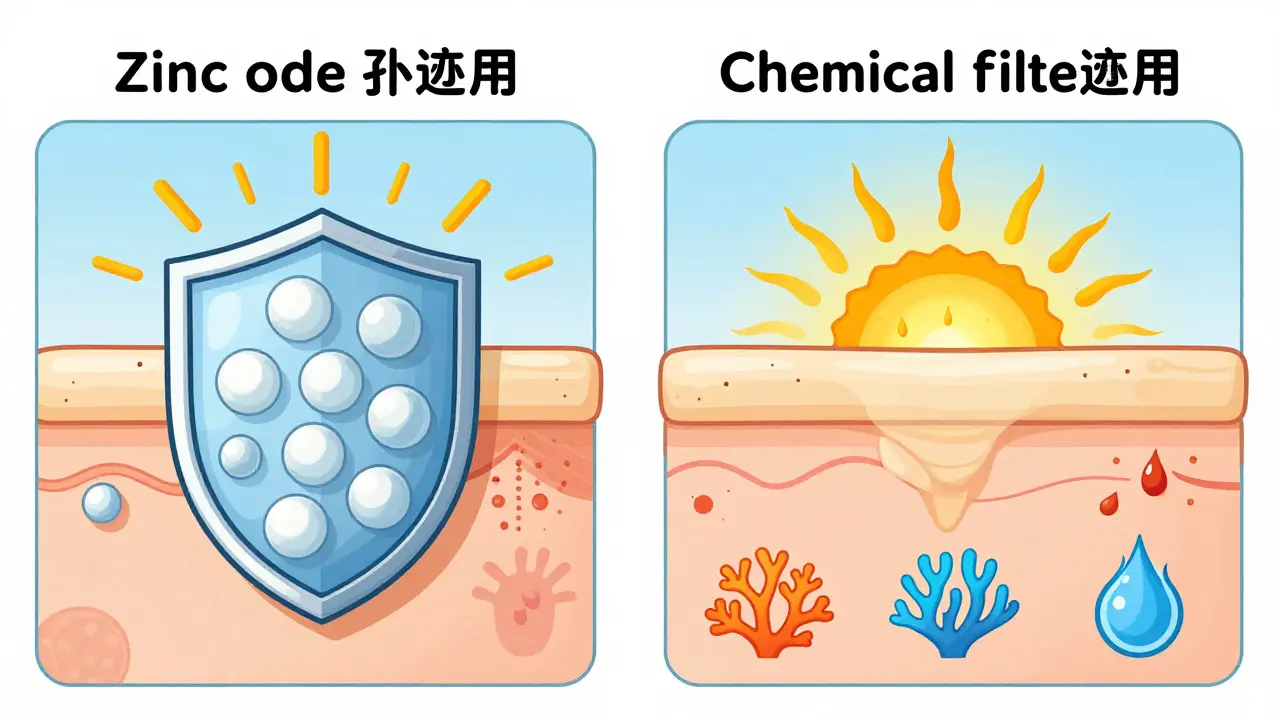
There are two main types of sunscreen: mineral and chemical. Mineral sunscreens use zinc oxide and titanium dioxide. They sit on top of your skin and physically block UV rays like a shield. Chemical sunscreens use ingredients like avobenzone, octinoxate, and oxybenzone. They absorb UV rays and turn them into harmless heat.
Mineral sunscreens are great for sensitive skin. They’re less likely to cause irritation or breakouts. But they can leave a white cast - especially on darker skin tones. That’s why many brands now use micronized or tinted versions. Brands like La Roche-Posay and CeraVe have made big strides in making mineral sunscreens that blend in better.
Chemical sunscreens are usually thinner, easier to spread, and don’t leave a white cast. But they can sting your eyes, clog pores, or trigger reactions in people with rosacea or eczema. Oxybenzone, in particular, has come under scrutiny for potential hormone disruption and coral reef damage. Many ‘reef-safe’ sunscreens now avoid it.
So which is better? There’s no single answer. If you have acne-prone or sensitive skin, try mineral first. If you hate the white cast and don’t react to chemicals, a good chemical sunscreen works fine. The best sunscreen is the one you’ll actually wear every day.
How Much to Use - And When to Reapply
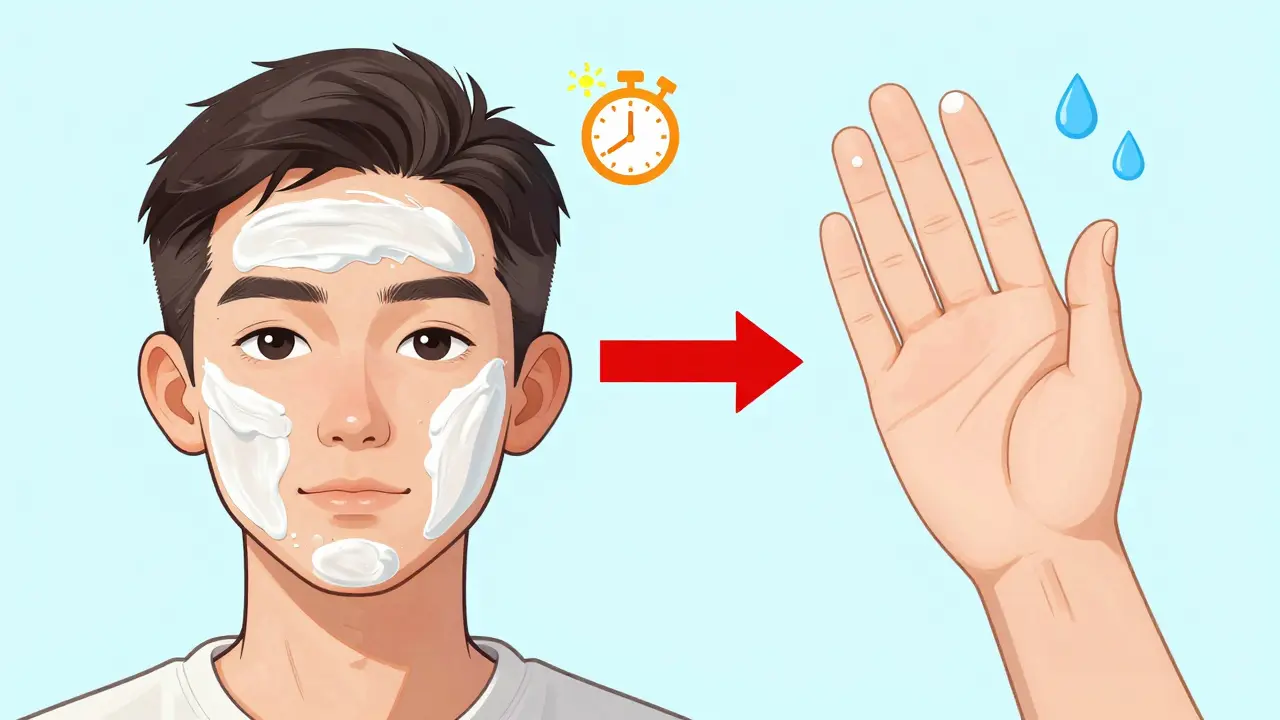
You’ve heard it before: use a shot glass full for your whole body. But for your face? You only need about a quarter teaspoon. That’s the amount that covers your face, neck, and ears. Most people use half that - or less. And that’s why your SPF 50 turns into SPF 10.
Reapplication is just as important. Sunscreen breaks down after two hours - especially if you sweat, swim, or wipe your face. Even ‘water-resistant’ sunscreens only last 40 or 80 minutes in water. If you’re outside all day, reapply every two hours. Don’t wait until you’re red. And if you’re wearing makeup, use a sunscreen spray or powder with SPF to touch up without ruining your look.
What to Look For - And What to Avoid
Here’s a simple checklist for choosing a daily sunscreen:
- SPF 30 or higher - Anything lower doesn’t give you enough protection.
- Broad spectrum - Non-negotiable. UVA protection matters as much as UVB.
- Mineral or chemical? - Pick based on your skin type. If you’re unsure, start with mineral.
- Look for zinc oxide or avobenzone - These give the most reliable UVA coverage.
- Avoid oxybenzone and octinoxate - If you care about reefs or sensitive skin, skip them.
- Water resistant if you sweat - Even if you’re not swimming, you might sweat.
And skip anything that says ‘sunblock’ or ‘waterproof.’ Those terms are banned by the FDA. No sunscreen is truly waterproof.
The Daily Habit That Changes Everything
You don’t need to be perfect. You don’t need to wear sunscreen on every single day of your life. But if you make it a habit - like brushing your teeth - you’ll see the difference in 5, 10, 20 years. People who use sunscreen daily have 50% less skin aging than those who don’t. That’s not marketing. That’s from a 2013 study published in the Annals of Internal Medicine.
And it’s not just about looks. Skin cancer is the most common cancer in the U.S. One in five Americans will develop it by age 70. Most of those cases are preventable. Sunscreen isn’t a luxury. It’s a daily shield. You wouldn’t skip your seatbelt. Don’t skip your sunscreen.
What’s Next for Sunscreen Science
The FDA is moving toward capping SPF labels at 60+, because higher numbers give diminishing returns and can mislead people into thinking they’re invincible. New research is also looking at protection against blue light from screens and infrared radiation from heat - both of which may contribute to skin aging. Some sunscreens already include antioxidants like vitamin C and E to help fight free radicals. In five years, we may see sunscreens that protect against UV, blue light, and pollution - all in one bottle.
For now, stick with the basics: SPF 30+, broad spectrum, applied generously, reapplied often. That’s all you need to protect your skin for decades to come.
Do I need sunscreen on cloudy days?
Yes. Up to 80% of UV rays penetrate clouds. UVA rays, which cause aging and long-term skin damage, are just as strong on overcast days. Skipping sunscreen because it’s cloudy is one of the biggest mistakes people make.
Can I rely on makeup with SPF instead of sunscreen?
Not reliably. Most people don’t apply enough foundation or powder to get the full SPF protection listed on the label. A tinted moisturizer with SPF 30 might only give you SPF 10 if you use the same amount you’d use for regular foundation. Use a dedicated sunscreen underneath your makeup.
Is higher SPF always better?
Not really. SPF 30 blocks 97% of UVB rays. SPF 50 blocks 98%. That extra 1% comes with a bigger price tag and often a thicker, greasier formula. The real problem isn’t the SPF number - it’s how much you apply. A properly applied SPF 30 is better than a poorly applied SPF 100.
Do I need sunscreen if I have dark skin?
Yes. While darker skin has more natural melanin, it’s not immune to UV damage. People with darker skin tones are more likely to die from melanoma because it’s often diagnosed later. UVA rays still cause aging, dark spots, and DNA damage. Sunscreen is just as important for everyone.
Why does my sunscreen pill under makeup?
Pilling happens when sunscreen doesn’t fully absorb before you apply other products. Let your sunscreen sit for 15 minutes after application. Also, avoid layering too many silicone-based products on top. Use a lightweight, fast-absorbing formula and apply sunscreen as the last step in your skincare routine, before makeup.


15 Comments
Daz Leonheart
Just started using sunscreen daily last year. Honestly? My skin has never looked better. No more random dark spots, no more that tired, dull look. I used to think it was overkill, but now I get it - it’s like brushing your teeth. You don’t see the difference day to day, but after five years? You’re way ahead of the game.
Samuel Bradway
I used to skip it because I thought I didn’t burn. Then I got a weird patch on my cheek that wouldn’t go away. Turns out, it was early sun damage. Never again. I’m 34 and my skin’s still okay because of this habit. Seriously, just put it on.
Zachary French
SPF 30 is the sweet spot? Please. You’re ignoring the fact that most people are applying sunscreen like they’re spreading butter on toast - thinly and unevenly. If you’re not using a full teaspoon on your face and neck, SPF 100 is just a placebo. The real issue isn’t the number - it’s the application. And no, your foundation with SPF doesn’t count unless you’re wearing a full face of it - which no one does. You’re fooling yourself.
Roshan Gudhe
It’s funny how we treat sunscreen like a chore. We brush our teeth, we wash our hands - why is this different? Maybe because we can’t see the damage until it’s too late. But think of it this way: every day you skip it, you’re quietly letting your skin age. Not just wrinkles - DNA damage. That’s not vanity. That’s biology. And biology doesn’t care if it’s cloudy or you’re inside. It just happens.
Lorena Druetta
My dermatologist told me to use mineral sunscreen because I have rosacea. I thought it would look like I had chalk on my face. But I tried CeraVe’s tinted version - it blends like magic. No white cast. Just smooth, protected skin. I wear it under makeup now. No one even notices. It’s not about looking perfect - it’s about protecting yourself. And honestly? It’s easier than I thought.
Alec Stewart Stewart
I used to think sunscreen was for beach days. Then I drove to work every day with the sun hitting my left cheek. Got a weird patch of darkening. Took me two years to realize it was sun damage. Now I use SPF 30 every morning, even in winter. My left side looks the same as my right. Small habits matter.
Demetria Morris
People who skip sunscreen are either ignorant or arrogant. You think melanin makes you invincible? That’s a myth. Skin cancer doesn’t discriminate by tone. And yet, Black and Brown people die at higher rates because it’s diagnosed later. Sunscreen isn’t optional. It’s survival. If you’re not using it, you’re not just being lazy - you’re risking your life.
Geri Rogers
Y’all are overcomplicating this. SPF 30 + broad spectrum + reapplied every 2 hours = done. No need for fancy labels or science degrees. Just pick one that doesn’t sting your eyes and stick with it. I use Neutrogena Ultra Sheer - it’s cheap, doesn’t pill, and I’ve been using it for 8 years. My skin? Still smooth. My dermatologist? Still happy. Simple wins.
Mandy Vodak-Marotta
I used to hate sunscreen. Too greasy. Too white. Too much work. Then I tried a new one - a lightweight gel-cream hybrid with niacinamide. It absorbs in 30 seconds, leaves zero residue, and actually makes my skin glow. I’ve been using it daily for a year. My friends keep asking if I got a facial. Nope. Just sunscreen. And honestly? I feel like a genius. If you think sunscreen is a chore, you just haven’t found the right one yet. Keep trying. It’s worth it.
Nathan King
The FDA’s SPF cap at 60+ is a necessary regulatory intervention, given the demonstrable placebo effect of SPF 100+ products. Consumers are systematically misled by marketing narratives that conflate numerical superiority with proportional protection. The logarithmic nature of UV absorption renders higher SPFs functionally redundant, and the resultant product viscosity often discourages adequate application. One must prioritize behavioral compliance over numerical inflation.
Janice Williams
How can anyone still believe that mineral sunscreen is ‘better’? Zinc oxide is a physical barrier - it’s like wearing a mask. Chemical sunscreens absorb the rays - they’re more elegant, more efficient. And yes, oxybenzone is a concern, but the studies are mostly on fish in labs, not humans. You’re trading real protection for a marketing trend. If you’re not using a chemical sunscreen, you’re under-protected. And don’t get me started on ‘reef-safe’ - that’s mostly greenwashing.
Jesse Naidoo
My ex used to say sunscreen made her look like a ghost. I told her she was being dramatic. She stopped using it. Two years later, she got melanoma. She’s fine now, but she’s scared. I still use mine. Every day. No excuses. I don’t care if you’re inside. I don’t care if it’s raining. UV rays don’t take days off. Neither should you.
rahulkumar maurya
Let me tell you something - the entire sunscreen industry is built on fear. They sell you a bottle for $25 and tell you it’s ‘essential.’ But the truth? Your body has natural defenses. Melanin. Antioxidants. Repair mechanisms. You don’t need a chemical cocktail on your face every morning. You need sunlight. Vitamin D. Fresh air. Stop being manipulated by corporate marketing. Go outside. Don’t hide.
Shelby Price
Wait - so if I use SPF 30 but apply half as much, I’m really only getting SPF 15? That’s wild. I always thought SPF was just a number. I’ve been using SPF 50 for years, but I’m probably just getting SPF 25. No wonder my skin still looks tired. Time to change my routine.
Keith Harris
You people are obsessed with SPF 30 like it’s some holy grail. Newsflash: the real problem isn’t sunscreen - it’s the fact that you’re all sitting inside all day, staring at screens, then suddenly going out for 10 minutes and expecting to be protected. You don’t need sunscreen. You need to stop pretending you’re outdoors. Go for a walk. Let your skin breathe. Or better yet - don’t live in a windowless cubicle. That’s your real problem.