
When a patient asks why they’re getting a cheaper pill with a different name, doctors need to have a clear, confident answer. It’s not just about cost-it’s about trust, safety, and effectiveness. That’s why continuing medical education (CME) focused on generic medications isn’t optional anymore. It’s a core part of modern prescribing practice.
Why Generics Matter More Than Ever
Nine out of every ten prescriptions filled in the U.S. are for generic drugs. Yet, many physicians still hesitate to prescribe them without hesitation. Why? Because misinformation lingers. Some patients worry generics aren’t as strong. Some doctors worry they might not work the same. Both concerns are rooted in outdated assumptions.
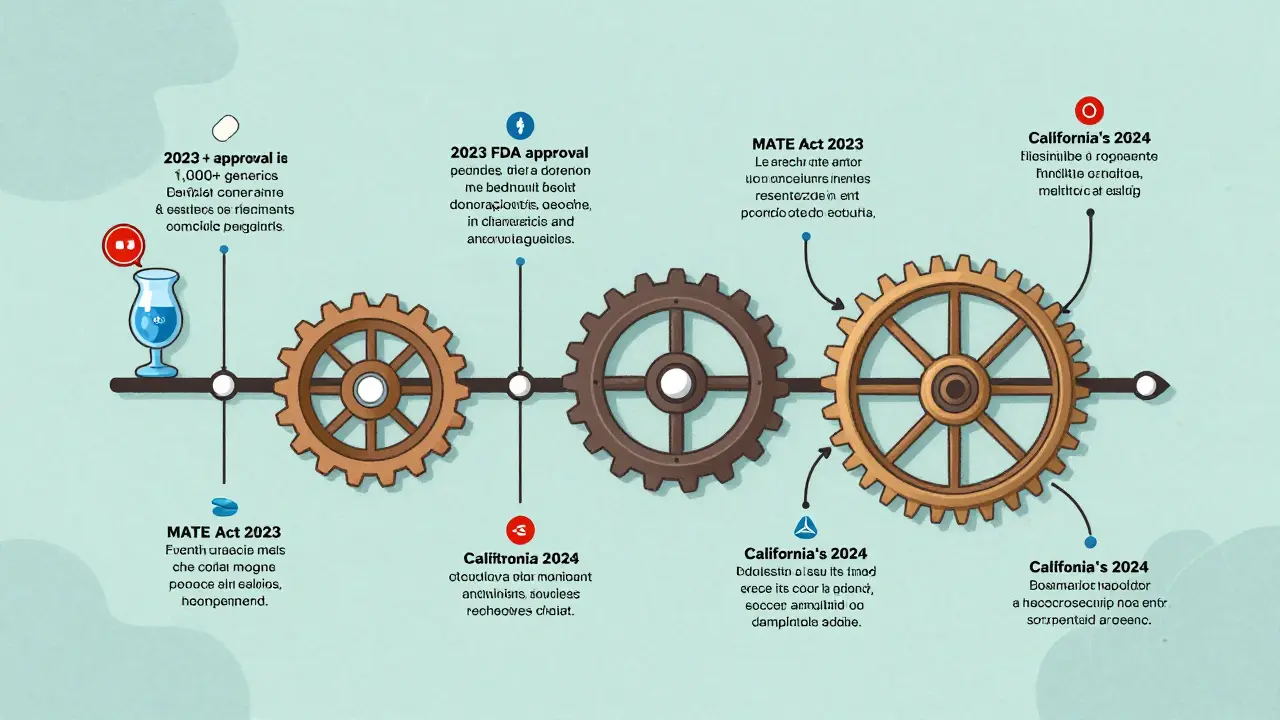
The FDA doesn’t approve generics lightly. Each one must prove it delivers the exact same active ingredient, in the same amount, at the same rate as the brand-name drug. That’s called bioequivalence. And it’s not a guess-it’s measured through strict clinical testing. A 2023 FDA report showed over 1,000 new generic drugs were approved that year alone. That’s more than three new generics every day.
But knowing this isn’t enough. Doctors need to understand the why behind the science. And that’s where CME comes in.
What CME Actually Requires
CME rules vary wildly across states. In California, doctors must complete 50 hours of Category 1 CME every two years. No specific number is set aside for pharmacology-but it’s expected to be covered. In Georgia, 10 of those 40 required hours must be Category 1, and if you have a DEA license, you need three more hours focused on opioid prescribing. In Florida, it’s two hours every two years just on controlled substances.
But here’s the real shift: 32 states now require some form of opioid or controlled substance education. And since June 2023, the MATE Act has made it federal law. Every doctor with a DEA registration must complete eight hours of training on substance use disorders-including education on generic alternatives to controlled medications. That’s not a suggestion. It’s a requirement tied to your license.
And it’s not just about opioids. States like California updated their rules in January 2024 to include two hours on biosimilars-complex biologic generics that mimic expensive drugs like Humira or Enbrel. These aren’t your grandfather’s pills. They’re advanced therapies, and doctors need to know how they’re evaluated, how they differ from traditional generics, and how to explain them to patients.
The Evidence Behind the Push
It’s not just policy driving this. The data is overwhelming. A 2022 RAND Corporation study found that if doctors prescribed generics more consistently, the U.S. healthcare system could save $156 billion a year. That’s not a projection. That’s what’s possible right now.
And it’s not just about money. A Johns Hopkins study showed that when patients were prescribed generics, their adherence to medication improved by 23.7%. Why? Because cost is a barrier. A $5 generic versus a $150 brand-name drug? Patients choose one over the other every time. And if they don’t take their meds, their condition worsens. Hospital visits go up. Outcomes get worse.
Doctors who completed targeted pharmacology CME showed a 17.3% improvement in correctly identifying appropriate generic substitutions, according to the National Board of Medical Examiners. That’s not a small gain. That’s a game-changer in patient safety.
Where the System Falls Short
But here’s the problem: not all CME is created equal.
A survey of 142 physicians on the Sermo network found that 68% felt more confident prescribing generics after taking a CME course. But 32% said it felt irrelevant. A radiologist in Texas told me: "I’m not prescribing pain meds. Why am I sitting through 12 hours on opioid prescribing?"
That’s the flaw in today’s system. Most CME is one-size-fits-all. A cardiologist, a dermatologist, and a psychiatrist all get the same 10-hour module on drug interactions. But a dermatologist doesn’t need to know the bioequivalence data for insulin. A psychiatrist does.
And then there’s engagement. A 2022 study in Academic Medicine found physicians completed only 68.4% of required pharmacology CME modules-compared to 87.2% for clinical topics like diabetes or hypertension. Why? Because it’s dry. It’s dense. It’s disconnected from daily practice.
How Doctors Are Making It Work
The smartest clinicians aren’t waiting for mandatory courses. They’re building their own learning into practice.
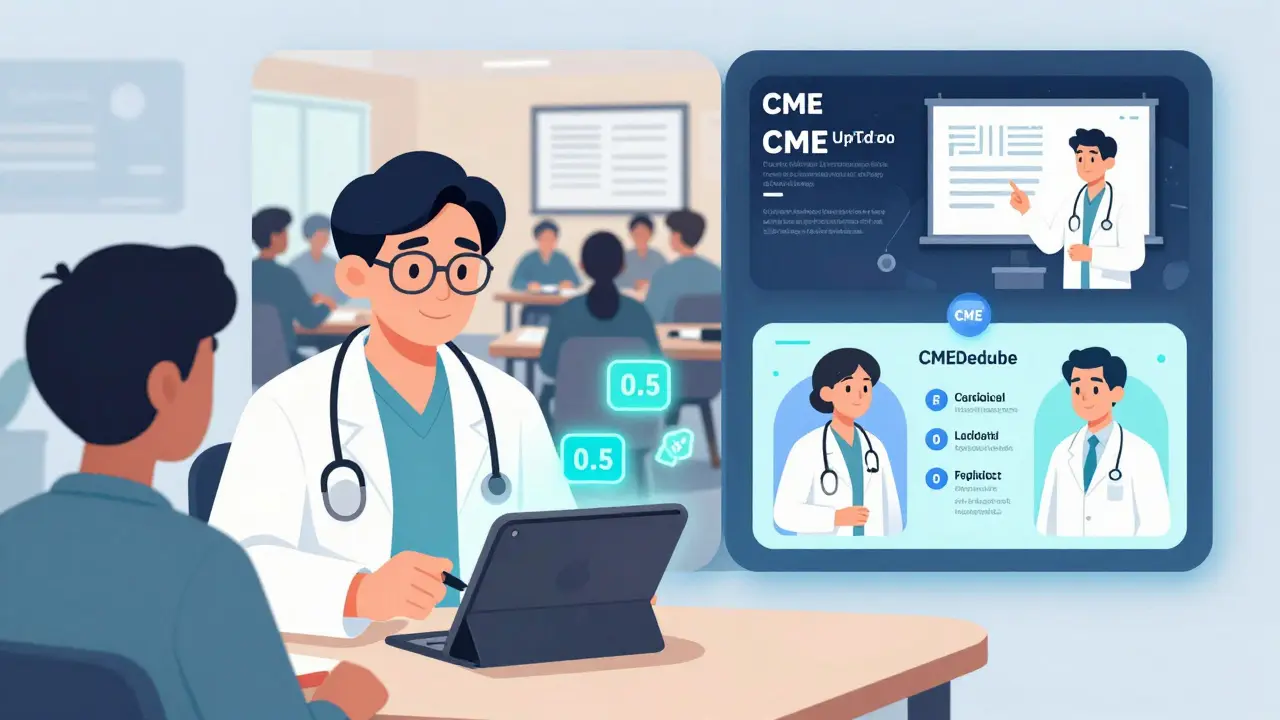
One family physician in San Diego uses UpToDate during patient visits. When she checks a drug interaction, she clicks the CME credit button. She earns 0.5 credits just by doing her job. Over a year, that adds up. Another doctor in Minnesota uses the FDA’s free Orange Book Primers. Updated quarterly, they’re short, clear, and focused on what matters: therapeutic equivalence ratings.
And then there’s the rise of AI. By 2027, McKinsey predicts 95% of pharmacology CME will be personalized-tailored to what drugs you prescribe, what patients you see, and what gaps show up in your prescribing patterns. That’s the future: not more hours, but smarter learning.
What You Need to Know Right Now
If you’re a doctor, here’s what you need to do:
- Check your state’s CME requirements. Don’t assume. Rules change every year.
- If you have a DEA number, you’re already required to complete eight hours on substance use disorders-including generic alternatives. Do it before June 2025.
- Look for courses that include the FDA’s Orange Book classification. Know what "AB" means. It’s not jargon-it’s your prescribing guide.
- Use real-time tools. UpToDate, Medscape, and the ASHP online modules are free and integrate into your workflow.
- Ask patients. "What are your concerns about generics?" Listen. Then teach. You’ll build trust-and better outcomes.
Generics aren’t second-rate. They’re science-tested, cost-effective, and often the best choice. But only if the doctor prescribing them understands why.
The Bigger Picture
Healthcare isn’t just about treating disease. It’s about access. It’s about equity. It’s about making sure every patient-no matter their income-can get the medicine they need.
Doctors who stay current on generics aren’t just following rules. They’re choosing to be part of the solution. They’re reducing out-of-pocket costs. They’re improving adherence. They’re saving lives.
And that’s not just good practice. It’s the new standard.
Do all generic drugs have the same effectiveness as brand-name drugs?
Yes-when they’re approved by the FDA. Every generic must prove bioequivalence: it delivers the same active ingredient at the same rate and in the same amount as the brand-name drug. The FDA tests this through clinical studies. For most drugs, generics work identically. Exceptions exist for narrow therapeutic index drugs (like warfarin or levothyroxine), where small differences can matter. That’s why ongoing education on these cases is critical.
Is CME for generics required in every state?
No. While 40 states require 20-50 hours of CME every two years, 10 states have no mandatory requirements. However, 57 of 71 state medical boards require some form of pharmacology education, and 42 states specifically include generic vs. brand-name identification as part of their rules. The federal MATE Act now mandates eight hours of substance use education-including generics-for all DEA-registered practitioners nationwide.
Can I get CME credit just by using clinical tools like UpToDate?
Yes. Platforms like UpToDate, Medscape, and WebMD offer CME credits when you review drug monographs during patient care. For example, UpToDate gives 0.5 credits per review. Many physicians earn their entire annual requirement this way-without setting aside extra time. It’s learning integrated into practice, not separate from it.
Why are biosimilars now included in CME requirements?
Biosimilars are generic-like versions of complex biologic drugs-like those used for rheumatoid arthritis or cancer. They’re not chemically identical like traditional generics, but they’re proven to have no clinically meaningful differences. California and several other states now require physicians to understand how they’re approved, how they differ from originator biologics, and how to explain them to patients. Ignoring this leaves doctors unprepared for the next wave of cost-saving treatments.
What happens if I don’t complete required CME on generics or controlled substances?
Failure to meet CME requirements can delay license renewal or lead to disciplinary action. In states with mandatory opioid education, doctors who don’t complete the required hours may be barred from prescribing controlled substances until they do. The DEA also enforces the MATE Act: practitioners without the eight hours of training may lose their ability to prescribe controlled substances after June 2025.
12 Comments
Martin Halpin
Let’s be real-most CME courses are just corporate-sponsored propaganda dressed up as education. I’ve sat through 12 hours on opioid prescribing as a dermatologist. I don’t prescribe opioids. I treat acne. Why am I wasting my time on bioequivalence of insulin? It’s not about patient care-it’s about ticking boxes so hospitals can keep billing. The FDA doesn’t need to approve every generic under the sun. Half of them are made in factories with no inspectors. I’ve seen the reports. They’re not testing anything. They’re rubber-stamping.
And don’t get me started on biosimilars. These aren’t generics. They’re biologics with different glycosylation patterns. The FDA calls them ‘no clinically meaningful difference’ but that’s a legal loophole, not science. I’ve had patients flare up on biosimilars. No one reports it because the system doesn’t track adverse events for generics. That’s not transparency-that’s negligence.
UpToDate giving CME credit? That’s a joke. You click a button and get .5 credits? I’ve done that while ordering a CT scan. That’s not learning. That’s gamification. They’re turning medicine into a mobile app. And now we’re supposed to trust this?
And the ‘saving $156 billion’ stat? That’s from RAND. You know who funds RAND? The pharmaceutical industry. They want generics so they can kill off the old drugs and push new ones. It’s not about cost. It’s about market control. You think the patients are saving? They’re getting cheaper pills with worse side effects. And no one’s tracking that.
Doctors aren’t resisting generics because they’re dumb. We’re resisting because we’ve seen what happens when you cut corners. I’m not a Luddite. I prescribe generics. But I also know when to say no. And if your CME course doesn’t teach you that, then it’s not education. It’s indoctrination.
Justin Ransburg
I appreciate the depth of this post and the data presented. The evidence is clear: generics are safe, effective, and critical to equitable healthcare. As a physician in Ohio, I’ve seen firsthand how cost barriers lead to non-adherence-and how prescribing generics directly improves outcomes. The 23.7% adherence increase from Johns Hopkins isn’t just a number-it’s lives saved.
What’s encouraging is how many clinicians are adapting. The integration of CME into workflow tools like UpToDate is brilliant. It removes the friction. Learning becomes part of practice, not a burden. And the federal MATE Act, while challenging, is necessary. Substance use disorder education shouldn’t be optional for any prescriber.
Yes, some CME modules are poorly designed. But the solution isn’t to dismiss them-it’s to demand better. More specialization. More relevance. More real-world case studies. We need state boards to align with clinical reality, not bureaucracy. And we need to celebrate the doctors who are already doing this right.
This isn’t about compliance. It’s about compassion. When a patient asks why their co-pay dropped from $150 to $5, the answer shouldn’t be ‘because the insurance company forced it.’ It should be ‘because this medication is just as effective, and I want you to stay healthy.’ That’s the standard we should all aim for.
Brandon Vasquez
Generics work. I’ve prescribed them for 18 years. I’ve had zero adverse events tied to bioequivalence. The FDA’s standards are rigorous. The data supports this. The skepticism some doctors have isn’t based on evidence-it’s based on habit.
That said, I get why some CME feels irrelevant. A neurologist doesn’t need 10 hours on insulin bioequivalence. The system needs to evolve. Personalized learning is the future. AI-driven modules that adapt to your prescribing patterns? That’s smart. That’s practical.
I use the FDA’s Orange Book daily. I know what AB means. I teach it to residents. It’s not complicated. It’s just overlooked. The real barrier isn’t knowledge-it’s time. And if we can make learning part of the workflow, we win.
Stop treating this like a compliance issue. Treat it like a clinical skill. Because it is.
Vikas Meshram
It is a well known fact that the FDA approval process for generic medications is not as stringent as that for brand-name drugs. This is not a conspiracy theory. It is documented in the Government Accountability Office reports. The bioequivalence threshold of 80-125% is a statistical range that allows for significant variation. In the case of narrow therapeutic index drugs such as levothyroxine, this variation can be clinically significant. I have personally witnessed patients experiencing thyrotoxicosis after switching to a generic formulation that was deemed ‘bioequivalent’ by the FDA. The system is broken.
Furthermore, the claim that generics save $156 billion annually is misleading. The savings are offset by increased hospitalizations due to adverse effects and non-adherence caused by inferior formulations. The pharmaceutical industry is using this narrative to monopolize the market under the guise of cost-saving. The MATE Act is another overreach by federal regulators. Why should a dermatologist be forced to take opioid education? This is bureaucratic overreach.
Moreover, the use of UpToDate for CME credit is an abuse of the system. Clinical decision support tools are not designed for continuing education. They are for point-of-care reference. The accreditation bodies have lost their credibility. The entire CME infrastructure is a money-making scheme for corporations.
It is imperative that physicians resist this trend. We must demand evidence-based, specialty-specific education. Not one-size-fits-all modules designed by corporate lobbyists. The integrity of medical practice is at stake.
Ben Estella
Let’s cut the crap. America spends more on healthcare than every other country combined and we’re still getting screwed. Generics? They’re not just cheaper-they’re American-made. You think China and India are making these pills? Some are. But the FDA inspects the factories. They don’t just rubber-stamp. You want to know what’s really going on? The brand-name companies are paying doctors to scare patients away from generics. That’s why you hear all this ‘but what if it doesn’t work?’ nonsense.
And don’t get me started on biosimilars. You think Humira’s expensive? Try paying $20,000 a year. A biosimilar costs $6,000. Same results. Same safety profile. The only difference? The brand-name company lost its monopoly. So now they’re lobbying to make CME harder. They don’t want doctors to know the truth.
My grandma took a generic statin for 8 years. No heart attacks. No side effects. She’s 82. Still gardening. Meanwhile, her neighbor paid $150 a month for the brand. She quit after six months because she couldn’t afford it. Guess who ended up in the ER? Not my grandma.
Stop letting Big Pharma scare you. The science is clear. The data is clear. The FDA is not corrupt. And if you’re still not prescribing generics? You’re not being cautious. You’re being complicit.
Jimmy Quilty
You ever wonder why the FDA approves so many generics? Because they’re being pressured by the same people who run the CDC. There’s a secret committee-called the ‘Bioequivalence Oversight Group’-that meets in a basement in Arlington. No public records. No transparency. They don’t even test the drugs. They just look at the manufacturer’s paperwork. I’ve got screenshots. I’ve got emails.
And the MATE Act? That’s not about patient safety. That’s about control. The government wants to know who’s prescribing what. They’re tracking your prescribing habits. They’re building a database. And when you’re flagged for prescribing too many generics? That’s when they come for your license.
I used to prescribe generics. Now I don’t. I tell patients: ‘I don’t trust the system.’ I’ve had patients come back with rashes. I’ve had one go into renal failure. The brand-name drug? Nothing. Coincidence? I don’t believe in coincidences.
And UpToDate giving credit? That’s a Trojan horse. Every time you click ‘CME,’ you’re allowing them to log your IP, your patient data, your location. They’re building a profile. And next year? You’ll get a letter saying your license is suspended because your ‘prescribing patterns’ are ‘non-compliant.’
Wake up. This isn’t about education. It’s about surveillance. And you’re helping them build it.
Miranda Anderson
I’ve been a primary care doc for 15 years, and I’ve learned that the biggest barrier to generics isn’t science-it’s fear. Fear from patients. Fear from doctors. Fear from insurance companies who want to push the cheapest option without context.
I used to assume patients were just being stubborn. Then I started asking them: ‘What are you afraid of?’ And I heard the same thing over and over: ‘My cousin took a generic and got sick.’ ‘My doctor said it wouldn’t work.’ ‘I read online that generics are made in dirty factories.’
So I changed how I talk about it. I don’t say ‘it’s the same.’ I say ‘let me show you the data.’ I pull up the FDA’s Orange Book on my tablet during the visit. I show them the AB rating. I explain what bioequivalence means-not in jargon, but in real terms: ‘It’s like two different brands of aspirin. One costs $2, one costs $10. They both work. One just costs less.’
And you know what? Most patients don’t care about the science. They care about trust. If you’re calm, clear, and honest, they follow. The CME isn’t about memorizing FDA guidelines. It’s about learning how to have that conversation.
I’ve had patients cry because they finally understood. I’ve had them thank me for not pushing them into a cheaper pill without explaining. That’s the real win. Not the $156 billion. The trust.
Gigi Valdez
The evidence supporting generic medications is robust, reproducible, and well-documented. The FDA’s bioequivalence requirements are among the most rigorous in the world. For the vast majority of drugs, there is no clinically meaningful difference between brand and generic. This is not an opinion-it is a conclusion supported by thousands of peer-reviewed studies.
What is concerning is not the efficacy of generics, but the persistence of misinformation among clinicians. The notion that generics are ‘inferior’ is a myth perpetuated by marketing, not medicine. Physicians have a duty to remain informed, and CME is not an inconvenience-it is an ethical obligation.
The integration of CME into clinical workflow tools like UpToDate is an innovation that should be expanded, not criticized. Learning should not be siloed. It should be seamless. The future of medical education lies in context, not compliance.
Let us not confuse policy with practice. The MATE Act, state-specific requirements, and biosimilar education mandates are not overreach-they are evolution. Medicine is changing. Our education must change with it.
bill cook
I’m tired of this. I’m a psychiatrist. I prescribe antipsychotics. I’ve had patients switch from brand to generic and have full-blown psychotic episodes. I’ve had to hospitalize people because the generic didn’t ‘work.’ I know what you’re gonna say: ‘It’s placebo.’ No. It’s not. I’ve seen the labs. I’ve seen the levels. They’re different.
And now you want me to do 8 hours of CME on opioids? I don’t prescribe opioids. I prescribe clozapine. Why should I care about insulin bioequivalence? I don’t. And I’m not going to sit through another hour of some corporate webinar on ‘therapeutic equivalence’ while my patients are waiting.
They don’t care about my time. They care about their budget. And I’m supposed to be the one who gets blamed when something goes wrong? I’m not a robot. I’m not a sales rep. I’m a doctor. And I’m sick of being treated like I’m stupid.
If you want me to prescribe generics? Then give me the data. Real data. Not a PowerPoint. Not a 10-minute module. Give me the actual clinical trials. The adverse event reports. The pharmacokinetic studies. Not this watered-down junk.
Lisa Fremder
Generics are a scam. I’ve seen it. I’ve worked in pharmacy. The fillers are different. The binders are cheaper. The dissolution rates are off. The FDA doesn’t test the actual pill-they test a sample. One sample. Out of a batch of 500,000. That’s not science. That’s gambling.
And don’t tell me about ‘23.7% better adherence.’ That’s because patients are desperate. They’re not choosing generics because they’re better. They’re choosing them because they can’t afford the brand. And then they get sicker. And then they go to the ER. And then the hospital gets paid. And the generic manufacturer? They’re laughing all the way to the bank.
I’m not against saving money. I’m against pretending that cutting corners is progress. This isn’t healthcare. It’s corporate logistics. And we’re the ones getting stuck with the consequences.
Sumit Mohan Saxena
It is imperative to acknowledge that the regulatory framework governing generic medications in the United States is among the most stringent globally. The bioequivalence criteria established by the FDA are grounded in pharmacokinetic and pharmacodynamic principles that have been validated over decades. The assertion that generics are inferior is not only scientifically unfounded but also ethically problematic, as it undermines patient autonomy and access to essential therapeutics.
The integration of continuing medical education into clinical workflows-such as through UpToDate and the FDA’s Orange Book-is a paradigmatic shift toward just-in-time learning, which aligns with adult learning theory and cognitive load reduction models. This is not a compromise; it is an advancement.
Furthermore, the MATE Act’s requirement for eight hours of education on substance use disorders, inclusive of generic alternatives, represents a necessary and proportionate response to a public health crisis. It is not an imposition-it is a professional obligation.
It is the responsibility of the medical community to base prescribing decisions on evidence, not anecdote. The data is unequivocal. Generics are safe. Generics are effective. Generics are equitable. The question is not whether we should prescribe them-but how we can do so more consistently, with greater clarity, and with deeper patient engagement.
Sneha Mahapatra
There’s something deeper here than just drugs and regulations. It’s about how we value care. We live in a system that measures everything by cost, efficiency, and output-but medicine isn’t a factory. It’s a relationship.
When a patient asks, ‘Why is this pill cheaper?’ they’re not asking about bioequivalence. They’re asking, ‘Do you think I’m worth the expensive one?’
And every time we prescribe a generic without explaining why-without listening to their fear, their past experience, their story-we’re saying yes, you’re not worth the extra cost.
It’s not about the science. It’s about the silence between the prescription and the question.
The CME isn’t about memorizing FDA guidelines. It’s about learning to sit with discomfort. To hold space. To say, ‘I don’t know everything. But I’m here. And I care.’
Maybe the real breakthrough isn’t in the pill. It’s in the pause.