
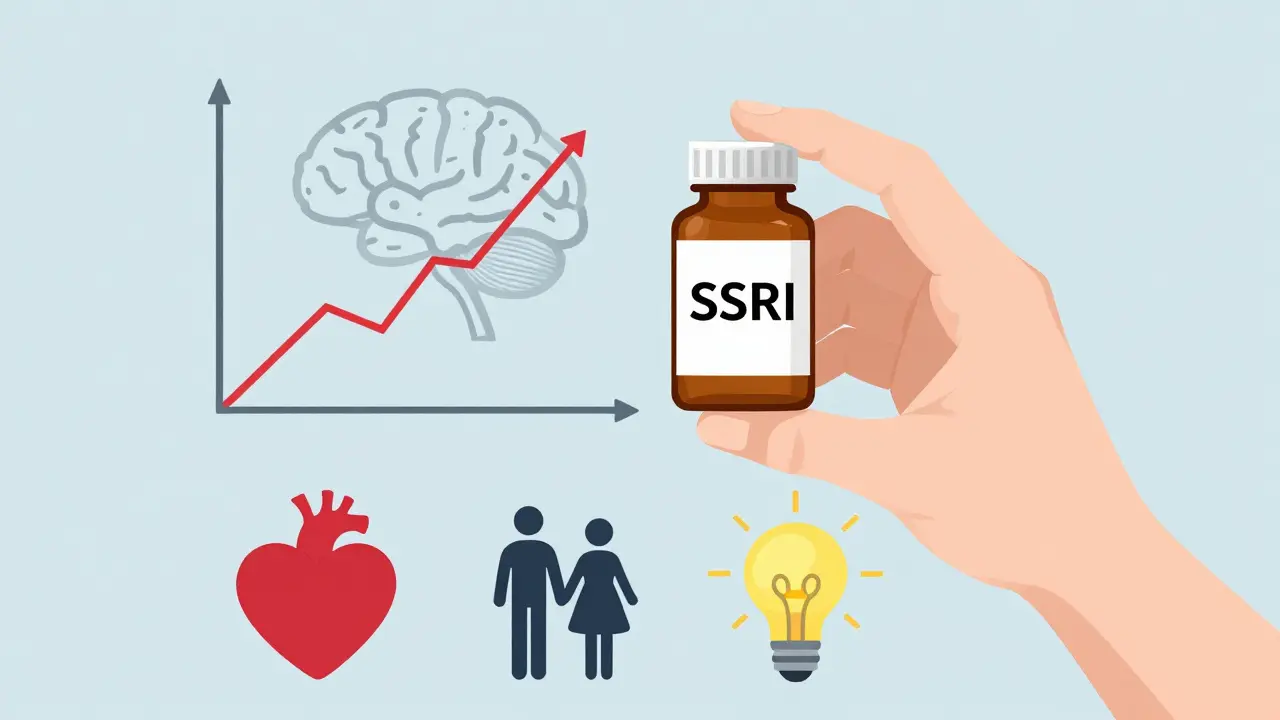
Sexual side effects from SSRIs are one of the most common reasons people stop taking their antidepressants. If you're on an SSRI and have noticed a drop in desire, trouble reaching orgasm, or difficulty getting or keeping an erection, you're not alone. Between 35% and 70% of people taking these medications experience some form of sexual dysfunction. And unlike other side effects like nausea or drowsiness, these issues don't always fade with time. They can stick around, damage relationships, and make people feel broken - even when their depression is improving.
Why This Happens
SSRIs work by increasing serotonin in the brain, which helps lift mood. But serotonin also plays a key role in sexual response. Too much of it can shut down desire, delay climax, and reduce physical arousal. This isn't a glitch - it's a direct effect of how the drug works. Symptoms usually show up within the first few weeks of starting the medication. For some, it's mild: less interest in sex. For others, it's severe: complete inability to orgasm, even after hours of stimulation. It's important to know that many people already had sexual issues before starting SSRIs. About one-third of people with depression report low libido or arousal problems even before treatment. That makes it harder to tell if the problem is the illness or the medicine. That’s why tracking symptoms before and after starting treatment matters.Dose Reduction: The Simplest First Step
Before jumping to switches or add-ons, try lowering the dose. Many people don’t realize that antidepressants often work at lower doses than what’s typically prescribed. For mild to moderate depression, reducing your SSRI by 25-50% can improve sexual function in 40-60% of cases without losing mood benefits. For example, if you're on 40 mg of sertraline daily, try 25 mg. If you're on 20 mg of escitalopram, drop to 10 mg. Do this slowly - over one to two weeks - and monitor how you feel. Some people find they feel just as good emotionally but regain sexual responsiveness. This approach works best when depression is stable and not severe. Don’t stop cold turkey. Even small reductions should be done under supervision. Sudden drops can cause withdrawal symptoms like dizziness, brain zaps, or anxiety.Drug Holidays: Timing It Right
A drug holiday means skipping your SSRI for 48-72 hours before planned sexual activity. This works well for SSRIs with short half-lives - like sertraline, citalopram, or escitalopram. These drugs clear from your system in a day or two, so pausing them briefly can restore sexual function without triggering a mood crash. Studies show this approach helps 60-70% of people with delayed orgasm or anorgasmia. But it won’t work for fluoxetine (Prozac). Fluoxetine sticks around for up to two weeks, so skipping a few days won’t make a difference. In fact, it might make withdrawal worse. There’s a catch: 15-20% of people experience withdrawal symptoms during the break - nausea, irritability, headaches. It’s not safe for people with severe depression or a history of relapse. Also, this method requires planning. It doesn’t work for spontaneous intimacy.Switching Antidepressants: A Strategic Move
If dose changes and holidays don’t help, switching medications is the next step. Not all SSRIs are equal when it comes to sexual side effects. Paroxetine is the worst offender - up to 70% of users report sexual dysfunction. Sertraline and escitalopram are slightly better, but still problematic for many. Better options exist outside the SSRI class. Bupropion (Wellbutrin) is the top choice. It doesn’t raise serotonin - it boosts dopamine and norepinephrine. Studies show 60-70% of people see improved sexual function after switching to bupropion. But it takes 2-4 weeks to kick in, and it can trigger anxiety or insomnia in some. It’s not ideal for people with seizures or eating disorders. Mirtazapine (Remeron) and nefazodone are also good alternatives. They block certain serotonin receptors, which helps sexual function. About half of users see improvement. But both cause drowsiness - up to 40% of people feel too tired to function during the day. Vilazodone and vortioxetine are newer antidepressants designed to cause fewer sexual side effects. They’re 25-30% better than traditional SSRIs in this area. But they cost 40 times more than generic sertraline. For many, that’s not an option.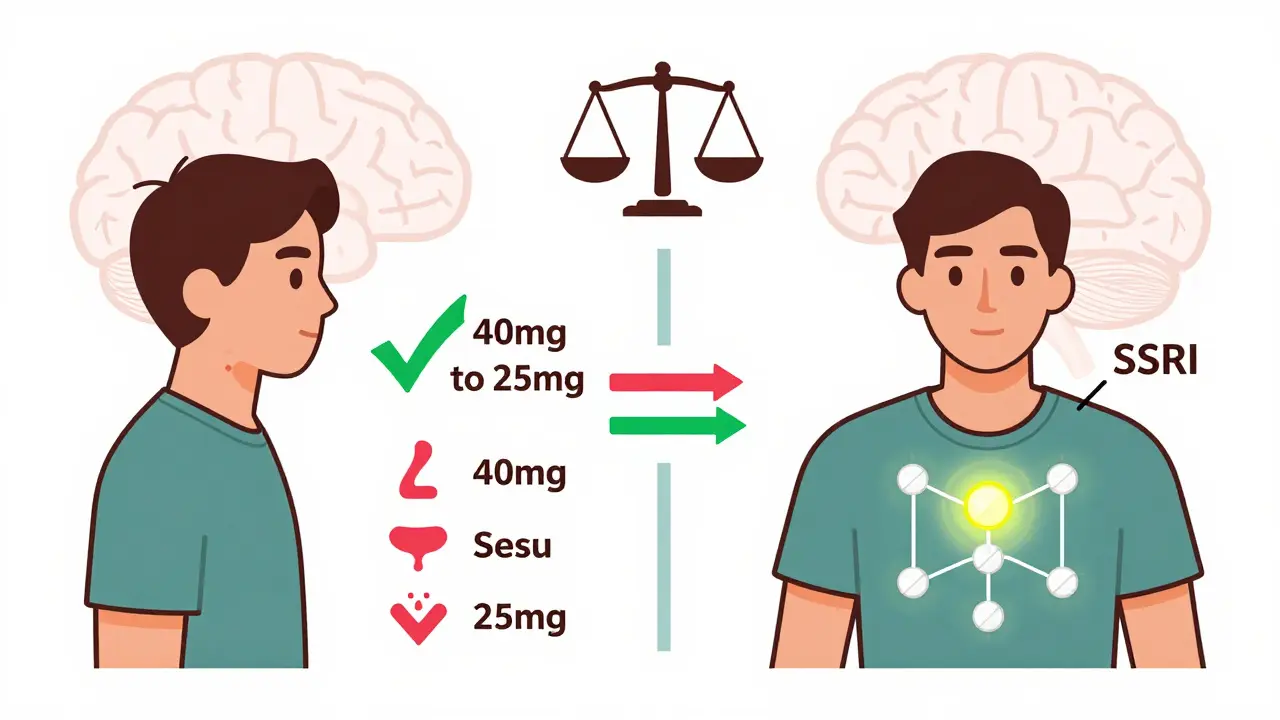
Adding Bupropion: The Most Proven Adjunct
Instead of switching, you can add bupropion to your current SSRI. This is called augmentation. In a double-blind trial of 55 people on SSRIs, adding bupropion (150 mg twice daily) led to a 66% improvement in sexual desire and frequency. That’s better than almost any other strategy. There are two ways to take it:- Daily dosing: 150 mg twice a day. Takes 2-4 weeks to work. Best for long-term improvement.
- As-needed dosing: 75 mg of immediate-release bupropion taken 1-2 hours before sex. Works in about 38% of cases. Good for people who don’t want daily medication.
Other Adjuncts: What Works and What Doesn’t
Several other drugs have been tried as add-ons:- Buspirone (Buspar): A 5-HT1A partial agonist. Improves sexual function in 45-55% of users. Takes 2-3 weeks. Very safe - only 5-10% stop due to side effects.
- Cyproheptadine: An antihistamine that blocks serotonin. Works in about half of people. But causes drowsiness in 35-40%. Not ideal for daytime use.
- Ropinirole or amantadine: Dopamine activators. Can help fast - within 48 hours. But they can cause tremors, nausea, or hallucinations. Riskier with fluoxetine.
Behavioral Strategies: More Than Just Medication
Medication isn’t the only tool. Many people improve with simple behavioral changes. Couples who practice “sensate focus” - non-goal-oriented touching, massage, and exploration - report 50% higher sexual satisfaction, even while still on SSRIs. One key insight: the problem isn’t always lack of desire. It’s dampened sensation. People still feel pleasure, but it’s muted. Trying new positions, using lubricants, incorporating fantasy, or increasing foreplay can help “override” the dampening effect. Communication matters too. Many people never tell their partners what’s happening. That breeds shame and distance. Talking openly - even just saying, “I’m on an antidepressant and my body isn’t responding like it used to” - can reduce pressure and rebuild intimacy.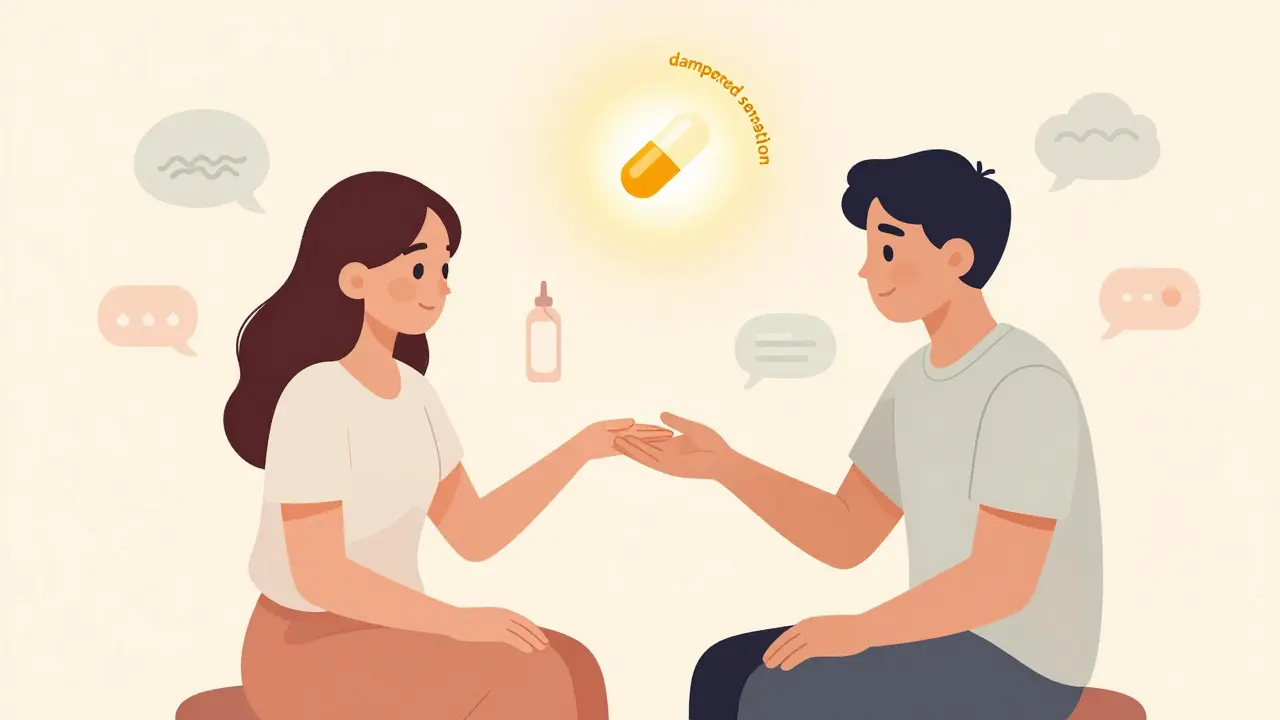
What About Persistent Sexual Dysfunction?
Some people report sexual problems that last months or even years after stopping SSRIs. The Therapeutic Goods Administration (TGA) issued a warning about this in June 2023. Case reports exist - people who took SSRIs for weeks or years and still couldn’t orgasm after quitting. But here’s the catch: we don’t know how common this really is. A 2023 review of 19 studies found only two well-designed trials. Most reports are from people online or in small surveys. It might be rare. Or it might be underreported because doctors don’t ask. If you’re experiencing this, you’re not imagining it. But don’t panic. Most people recover. Support groups like SSRI Stories have 15,000+ members who share experiences and coping strategies. There’s no proven cure yet, but some find relief with pelvic floor therapy, acupuncture, or low-dose testosterone (for men).What Should You Do?
Here’s a practical plan:- Track your symptoms. Use a simple journal: rate desire, arousal, orgasm, and satisfaction on a scale of 1-10 before and after starting the SSRI.
- Ask your doctor to screen you. Only 42% of primary care doctors know the right next steps. Ask: “Can we use the Antidepressant Sexual Dysfunction Inventory?”
- Start with dose reduction. If your depression is stable, try lowering your dose by 25% for 2-4 weeks.
- Try a drug holiday. If you’re on sertraline or citalopram, skip your pill for 48 hours before sex. Watch for withdrawal.
- Consider bupropion. Either switch to it or add it. Start low. Go slow. Watch for anxiety.
- Try behavioral fixes. Talk to your partner. Experiment. Don’t rush.
- Don’t give up. There’s almost always a solution. But you have to speak up.
Final Thoughts
SSRI-induced sexual dysfunction isn’t a sign you’re failing. It’s a known, common, and treatable side effect. The real failure is when doctors don’t talk about it before prescribing. You deserve to feel good - emotionally and physically. There’s no one-size-fits-all fix. What works for one person might not work for another. But with the right approach - careful dose changes, smart switches, smart add-ons, and honest communication - most people can get back to a satisfying sex life without giving up their antidepressant.Don’t wait until your relationship is strained or you quit your meds. Talk to your provider today. Bring this article. Ask for options. You’re not alone, and you’re not broken.
Can SSRI sexual side effects go away on their own?
For some people, sexual side effects improve slightly after a few months as the body adjusts. But for most, they don’t go away without intervention. Studies show that without treatment, over 60% of people still have issues after six months. Waiting rarely helps - it’s better to act early.
Is it safe to take bupropion with my SSRI?
Yes, for most people. Combining bupropion with SSRIs is a well-studied strategy and is often effective. But it can increase anxiety or trigger panic attacks in about 20-25% of users, especially with fluoxetine. Start with a low dose (75 mg daily) and increase slowly. Never combine if you have a history of seizures or eating disorders.
Why doesn’t a drug holiday work with Prozac?
Fluoxetine (Prozac) has a very long half-life - up to 14 days. That means it stays in your system for weeks. Skipping a dose or two won’t lower its concentration enough to help sexual function. In fact, it can cause withdrawal symptoms like dizziness, nausea, or mood swings without giving you any benefit.
How long does it take for bupropion to help with sexual function?
It takes time. Daily bupropion usually shows improvement in 2-4 weeks. As-needed use (75 mg before sex) can work within 1-2 hours, but results are less consistent. Don’t give up after a week - wait at least 3 weeks before deciding if it’s working.
Are there any natural supplements that help?
No supplement has strong evidence for treating SSRI-induced sexual dysfunction. Ginseng, maca, and L-arginine are often promoted, but studies are small, poorly designed, or show no real benefit. Some herbs can even interact with SSRIs and cause serotonin syndrome. Stick to proven medical approaches and talk to your doctor before trying anything.
Should I stop my SSRI if sexual side effects are bad?
Don’t stop abruptly. Stopping suddenly can cause withdrawal symptoms - brain zaps, dizziness, nausea, or even a return of depression. Instead, talk to your prescriber. There are safer ways to manage this - dose changes, switches, or add-ons. Stopping without a plan puts your mental health at risk.
What if nothing works?
If all standard options fail, consider seeing a specialist - a psychopharmacologist or sexual medicine expert. Some people benefit from pelvic floor therapy, low-dose testosterone (for men), or even experimental treatments like MK-0941 (a 5-HT2C antagonist currently in phase II trials). You’re not out of options - you might just need a different kind of care.
9 Comments
Michael Dillon
This is the most practical guide I've read on SSRI sex issues. Dose reduction and drug holidays are underused. Why do doctors act like these side effects are some kind of moral failing?
Zabihullah Saleh
I've been on sertraline for 3 years. The sexual side effects were brutal at first. I dropped to 25mg and it didn't just help my libido-it made me feel like myself again. Not broken. Not defective. Just human. And yes, I still cry during rom-coms. But now I can kiss my partner without feeling like a robot with a broken switch.
It took me 18 months to say that out loud. Don't wait. Talk to your doctor. Bring this article. They'll be glad you did.
Carlos Narvaez
The bupropion augmentation data is statistically significant but clinically overhyped. 66% improvement? That's not a cure. It's a partial mitigation. And the anxiety risk? Not worth it for most. Also, 'sensate focus' is just fancy talk for touching without expectations. Cute.
Harbans Singh
I'm from India and we don't talk about this stuff. My cousin took escitalopram and stopped sex for 2 years. Family thought he was 'lazy'. No one knew SSRIs could do this. I printed this article and gave it to my uncle. He cried. We finally talked. Thank you for writing this. It's not just medical-it's cultural.
Justin James
You know what they don't tell you? The pharmaceutical companies know this side effect is rampant. That's why they push the higher doses. They want you dependent. They want you stuck. They don't want you switching to bupropion because it's generic and cheap. And don't get me started on the 'drug holiday'-that's just a loophole they designed you to exploit so you keep buying the brand name. The FDA is complicit. The whole system is rigged. They profit from your broken sex life.
Winni Victor
So let me get this straight. I'm supposed to take a pill that makes me feel less depressed... but also makes me feel like a eunuch? And the solution is to take ANOTHER pill that might give me panic attacks? And if that doesn't work, I'm supposed to 'explore new positions'? Like I'm in a Cosmo article. I'm not a lab rat in a sex experiment. I just want to feel alive without having to choreograph my orgasm.
Terry Free
If you're having sex problems on SSRIs, you're probably just not trying hard enough. Or maybe you're too lazy to communicate. My wife and I have been together 12 years. I've been on fluoxetine since 2015. We have sex once a month. It's fine. We talk. We laugh. We don't need fancy hacks. You're overcomplicating it. Just be grateful you're not suicidal.
Lindsay Hensel
This article is a lifeline. Thank you for writing it with such clarity and compassion. The stigma around SSRI-induced sexual dysfunction is profound, and your tone-neither clinical nor dismissive-creates space for real healing. I will share this with my therapist and my partner. We have been silent too long.
Linda B.
I stopped my SSRI cold turkey after 6 months and still can't cum 3 years later. No one believed me. Doctors called it psychosomatic. Then I found a Reddit thread. 15k people. Same story. They're hiding this. The trials are rigged. The FDA knows. The drug reps know. You think this is coincidence? It's not. It's a silent epidemic. And they're letting us suffer because we're not dying. We're just broken in the bedroom.