
Statin Timing Decision Tool
What statin are you taking?
For years, doctors told patients to take statins at night. The logic was simple: your liver makes most of its cholesterol while you sleep, so taking the drug at bedtime would hit the target when it mattered most. But that advice doesn’t hold up for everyone anymore. Today, whether you take your statin in the morning or at night depends less on the clock and more on the statin you’re on-and whether you can actually remember to take it.
Why Timing Used to Matter
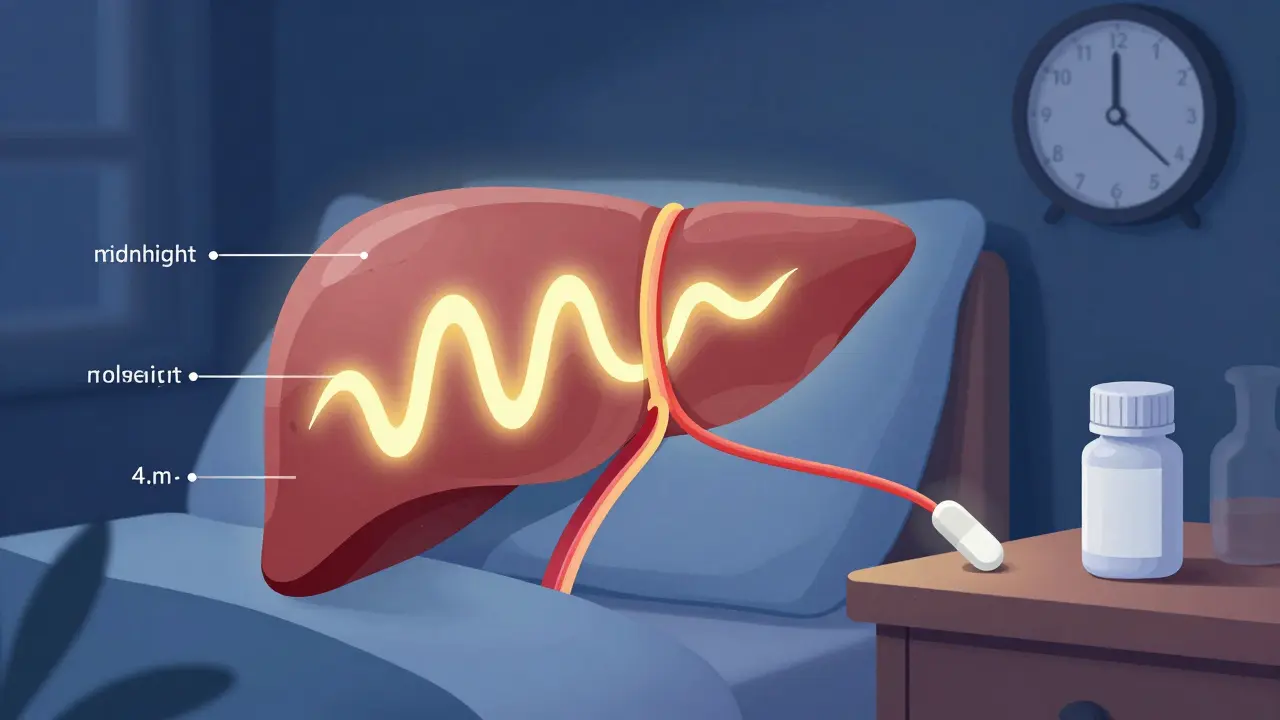
Back in the 1980s, when statins like simvastatin and lovastatin first hit the market, they didn’t last long in your body. Their half-lives were short-just a few hours. That meant if you took them in the morning, the drug was mostly gone by midnight, when cholesterol production peaked. Studies showed clear benefits: one trial found simvastatin 5mg taken at night lowered cholesterol by 21%, but only 14% when taken in the morning. That’s a 50% boost in effectiveness just from timing. The science behind it was solid. Research from the 1970s and 80s confirmed that your liver ramps up cholesterol synthesis between midnight and 4 a.m., especially if you’re fasting. So, having the highest drug concentration in your blood during those hours made sense. For short-acting statins, evening dosing wasn’t just helpful-it was necessary to get the full benefit.Not All Statins Are the Same
Here’s where things changed. Newer statins like atorvastatin, rosuvastatin, and pitavastatin stick around much longer. Atorvastatin lasts 14 to 20 hours. Rosuvastatin? Nearly 20 hours. That means even if you take them at 8 a.m., you still have enough drug in your system at 2 a.m. to block cholesterol production. A 2017 analysis of 17 studies involving over 3,300 people showed the difference: for short-acting statins, evening dosing lowered LDL cholesterol by 7.3% to 15% more than morning dosing. But for long-acting statins? The difference was tiny-less than 2.5 mg/dL, or about 2-3%. That’s below the threshold doctors consider clinically meaningful. In other words, if you’re on rosuvastatin or atorvastatin, taking it in the morning doesn’t hurt your results.Side Effects: Does Timing Make a Difference?
One big concern people have is muscle pain, or myalgia. Some worry taking statins at night might make side effects worse. But data says otherwise. Analysis of over 4 million statin prescriptions from the FDA’s adverse event database found no difference in muscle pain, liver enzyme spikes, or diabetes risk between morning and evening doses. The rates were almost identical: 8.9% for morning, 8.7% for night. No statistically significant difference. Even the rare but serious side effect-rhabdomyolysis-shows no link to timing. What matters more is your dose, age, kidney function, and whether you’re taking other drugs that interact with statins. So if you’re worried about side effects, don’t blame the time of day. Look at your overall medication plan instead.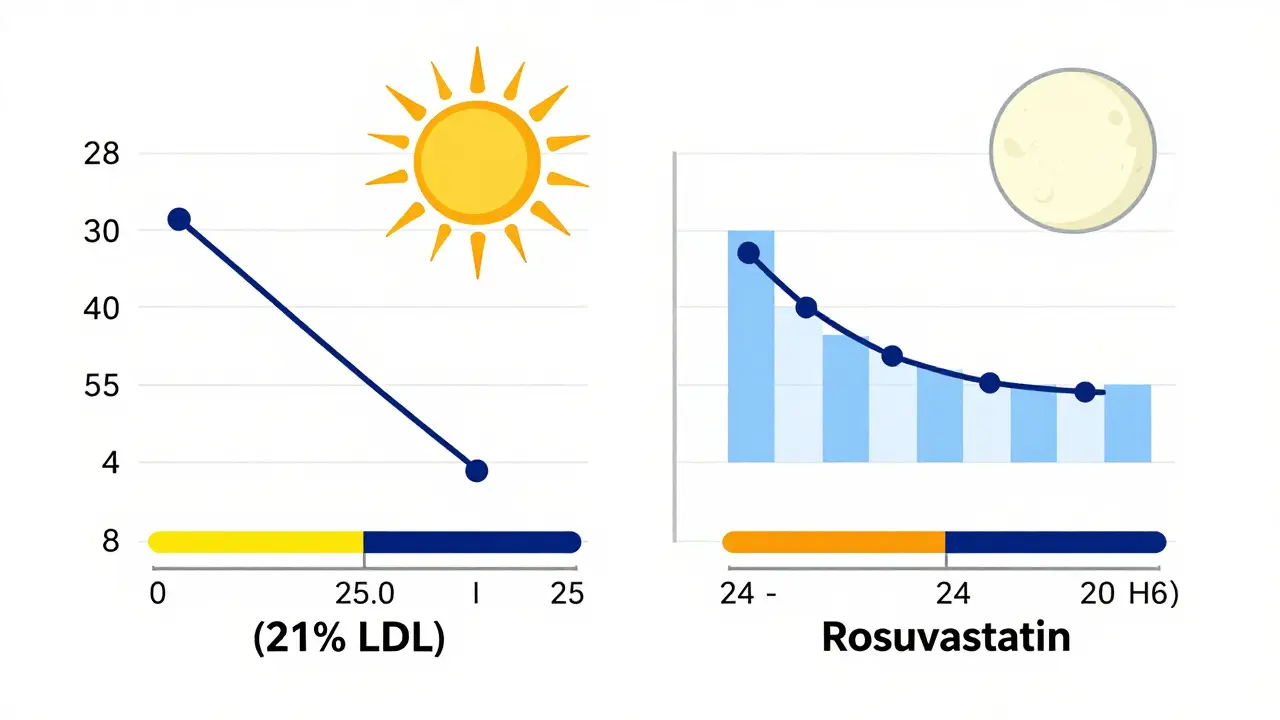
Adherence Is the Real Game-Changer
Here’s the twist: the biggest threat to statin effectiveness isn’t timing-it’s forgetting to take it. A 2019 study of nearly 12,500 patients found that those told to take statins at night had 11.3% lower medication adherence than those taking them in the morning. That’s over two extra missed doses per month. Missed doses mean higher LDL levels. And higher LDL means higher heart attack risk. Real stories back this up. One Reddit user shared how they kept forgetting simvastatin at night. Their doctor switched them to morning rosuvastatin-and their LDL dropped because they finally started taking it every day. Another patient said they took their statin at night for years, but their schedule kept changing. Once they moved to morning, they never missed a dose again. Their cholesterol improved. The American College of Cardiology says it plainly: consistency beats clock time. If you’re on a short-acting statin and you’re forgetting to take it at night, switching to morning-even if it’s slightly less effective-is better than skipping doses entirely.What Should You Do?
If you’re on a short-acting statin like simvastatin, lovastatin, or fluvastatin: evening dosing still gives you the best chance at maximum LDL reduction. But if you struggle to remember it at night, talk to your doctor. A morning dose with a phone reminder might be better than a perfect nighttime dose you never take. If you’re on a long-acting statin-atorvastatin, rosuvastatin, pitavastatin, or pravastatin-timing barely matters. Take it when it fits your life. Morning with breakfast? Fine. Evening with dinner? Also fine. The goal is to take it every day, not at the exact right hour.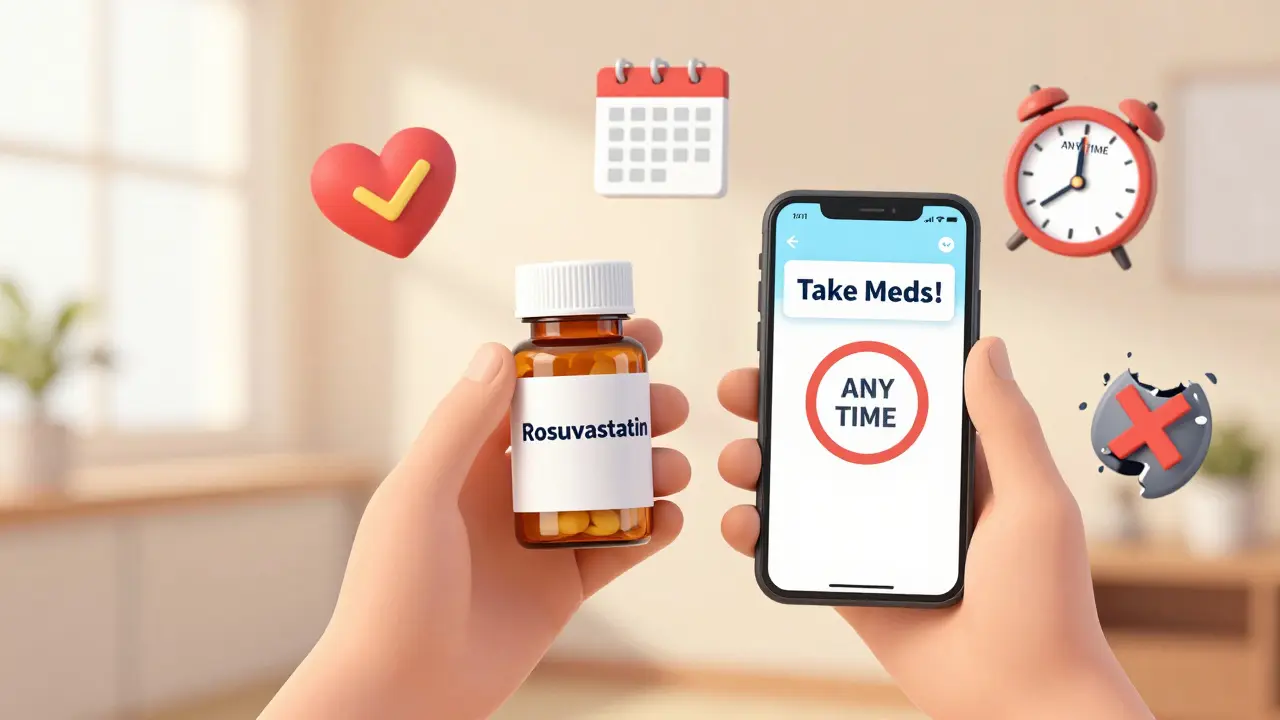
What Doctors Are Doing Now
Ten years ago, nearly 70% of doctors routinely asked patients about statin timing. Today, that number is down to 18%. Why? Because most new prescriptions are for long-acting statins. In fact, 82% of new statin prescriptions in 2023 were for atorvastatin or rosuvastatin. That’s a huge shift from 2010, when only 55% were long-acting. Pharmacists now commonly recommend morning dosing for all statins unless the patient is on a short-acting version and has no trouble with nighttime dosing. The American Pharmacists Association survey found 68% of pharmacists give this advice. Why? Because adherence is the only thing that reliably lowers heart attack risk.What’s Next?
Researchers are still studying this. The TIMING trial, a 10,000-patient study comparing morning and evening dosing of simvastatin, is expected to wrap up in late 2024. Early results won’t change much for most people, but they might help fine-tune guidelines for specific groups. Meanwhile, drug companies are exploring new delivery systems. Pfizer has a patent for a timed-release simvastatin that slowly releases the drug overnight-so you could take it in the morning and still get nighttime coverage. If it gets approved, it could end the debate entirely.The Bottom Line
The old rule-"take statins at night"-only applies to a shrinking group of patients. For most people today, the best time to take your statin is the time you’ll actually remember. If you’re on a long-acting statin, you have freedom. If you’re on a short-acting one, evening is ideal-but not worth missing doses over. Your heart doesn’t care what time you take your pill. It only cares that you take it. Every day.Should I take my statin at night or in the morning?
It depends on which statin you’re taking. If you’re on simvastatin, lovastatin, or fluvastatin, evening dosing gives slightly better cholesterol reduction. But if you forget to take it at night, switching to morning is better than missing doses. If you’re on atorvastatin, rosuvastatin, pitavastatin, or pravastatin, timing doesn’t matter-take it whenever works best for you.
Does taking statins at night cause more side effects?
No. Studies analyzing millions of prescriptions show no difference in muscle pain, liver issues, or diabetes risk between morning and evening dosing. Side effects are linked to your dose, age, other medications, and genetics-not the time of day.
Can I switch my statin from night to morning?
Yes, if you’re on a long-acting statin like atorvastatin or rosuvastatin, switching to morning is safe and won’t affect your results. If you’re on a short-acting statin like simvastatin, talk to your doctor first. If you’re struggling to remember nighttime doses, switching to morning-even with a slight drop in effectiveness-is better than skipping doses.
Why do some doctors still say to take statins at night?
Some doctors learned the old guidelines and haven’t updated their practice. Others may be prescribing older statins or working with patients who still benefit from evening dosing. But the evidence now clearly shows that for most people, especially those on newer statins, timing is not critical.
What if I miss a dose? Should I take it the next morning?
If you miss a dose, take it as soon as you remember-but don’t double up the next day. If it’s almost time for your next dose, skip the missed one. Statins work best with consistent daily use, not perfect timing. Missing one dose occasionally won’t undo your progress, but frequent misses will raise your risk.
Are there any statins that must be taken at night?
Simvastatin and lovastatin are the only ones where evening dosing still offers a meaningful advantage. Even then, if you can’t take them at night, morning dosing with a reminder system is better than skipping. Fluvastatin is short-acting too, but less commonly used. All other statins-atorvastatin, rosuvastatin, pravastatin, pitavastatin-can be taken anytime.

12 Comments
Lu Jelonek
I switched from simvastatin at night to rosuvastatin in the morning last year after forgetting doses for months. My LDL dropped 18 points-not because of the drug change, but because I actually started taking it. Funny how the simplest fix is often the one we ignore.
Now I take it with my coffee. No more midnight panic checks.
Ademola Madehin
Bro this whole thread is wild 😭 I was taking my statin at 3am because my cousin said ‘night is best’ and now I’m waking up with leg cramps and wondering if I’m gonna turn into a zombie.
Turns out I’m on atorvastatin. I just moved it to 8am and my life changed. No more 3am alarms. I’m free.
Jeffrey Frye
So let me get this straight. You’re telling me that after 40 years of ‘take it at night,’ the entire medical community just… changed their minds because some statins last longer?
And now we’re supposed to believe that adherence > timing? That’s not science, that’s behavioral economics dressed up as pharmacology. Also, who wrote this article? A pharmacy rep with a thesaurus?
Andrea Di Candia
It’s kind of beautiful, really. Medicine is finally catching up to the fact that humans aren’t robots. We forget things. We have chaotic lives. We sleep late. We work nights. We binge-watch shows until 2am.
Instead of forcing us to conform to a schedule that doesn’t fit our biology, why not let the medicine adapt? The goal isn’t to be perfect-it’s to be consistent. That’s the real win.
Also, if your doctor still insists on nighttime dosing for rosuvastatin, politely ask them when they last updated their knowledge. Not to be rude. Just curious.
Joseph Manuel
While the article presents a compelling narrative, it lacks rigorous meta-analytic weighting of the comparative efficacy data. The 2.5 mg/dL difference cited is statistically insignificant, yet the clinical relevance remains debatable in high-risk populations. Additionally, the adherence data from 2019 conflates self-reported compliance with actual serum levels, introducing significant measurement bias.
Further, the FDA adverse event analysis does not control for concomitant medications or renal impairment, which are critical confounders in myalgia risk. Until longitudinal RCTs with pharmacokinetic monitoring are published, the recommendation to abandon evening dosing remains premature.
Lindsey Kidd
OMG I’m crying 😭 I’ve been taking my statin at night for 7 years and my husband kept forgetting to remind me. I switched to morning and now I take it with my vitamins and I haven’t missed one in 4 months. My doctor was like ‘huh, that’s weird’ and I was like ‘nope, it’s not weird, it’s called being human.’ 🙌
Also, I now have more sleep. And less anxiety. And I didn’t even know I was stressed about it until it was gone. 🤍
Rachel Cericola
Let’s be real-this isn’t about science. This is about systems design. The original ‘take at night’ rule was created when we had no digital reminders, no pill organizers, and no understanding of behavioral psychology. Now we have apps, alarms, and smart bottles. So why are we still clinging to a 1985 protocol?
And yes, I’ve seen patients on simvastatin who swear by nighttime dosing. But here’s the kicker: those same patients also take their blood pressure meds at night, their thyroid pills in the morning, and their supplements at lunch. Their schedule is a mess. So we move them to morning statins and suddenly their adherence jumps from 54% to 89%.
It’s not magic. It’s logistics. The body doesn’t care when you take it. Your calendar does.
Also, if you’re on a short-acting statin and you’re not forgetting doses? Great. Keep doing it. But don’t shame the person who switched to morning because they work nights and sleep during the day. We’re not here to win a purity contest. We’re here to stay alive.
Blow Job
My dad was on simvastatin for 12 years. Took it at 10pm sharp. Never missed. Then he got prescribed a new one-atorvastatin-and the pharmacist told him to take it with breakfast. He panicked. Thought he’d have a heart attack.
I told him: ‘Dad, you’ve been taking this pill for over a decade. You didn’t take it because it was magic. You took it because you cared about your heart.’
He switched. No issues. LDL down. Sleep better. No more midnight bathroom runs.
Medicine isn’t about rituals. It’s about habits. And habits stick when they fit your life, not the other way around.
EMMANUEL EMEKAOGBOR
It is truly remarkable how the evolution of pharmacological science continues to align with human behavioral realities. In Nigeria, where adherence challenges are compounded by inconsistent electricity and unreliable pharmacy supply chains, the notion of rigid timing becomes not merely impractical, but potentially harmful.
Many patients here are prescribed statins without clear instructions, and the most common question is: 'When do I take this?' The answer should never be ‘at night’ if it leads to non-compliance. Consistency, as you rightly point out, is the only immutable variable.
May this wisdom spread beyond Western clinics.
CHETAN MANDLECHA
My uncle in India was told to take rosuvastatin at night. He’d forget. Then he started taking it with his morning chai. His doctor was shocked. But his cholesterol improved. Now he tells everyone: ‘If your pill doesn’t fit your day, change the day.’ Simple. No jargon. Just life.
Jillian Angus
took mine at night for 5 years
switched to morning last month
no idea if it worked
but i sleep better now
and i dont have to remember
so yeah
Paula Villete
Wow. After 20 years of medicine telling us to take statins at night, we’re finally admitting that the real enemy isn’t cholesterol-it’s our own forgetfulness.
And the kicker? The same people who told us to take it at night are now the ones who won’t admit they were wrong.
So here’s to the pharmacists who quietly changed the game. And to the patients who just wanted to live without setting 3 alarms.
Also, if your doctor still says ‘night only’ and you’re on rosuvastatin… you might want a new doctor. Just saying. 🧐