
Warfarin Vitamin K Tracker
Your vitamin K intake should be consistent, not necessarily low. This tool helps you track your daily vitamin K intake to maintain stable INR levels. Enter the foods you consume daily and see how your intake compares to your average.
Enter your data to see your vitamin K consistency
Warfarin saves lives. It keeps dangerous blood clots from forming after heart valve replacements, deep vein thrombosis, or atrial fibrillation. But for every person who finds stability on warfarin, there’s another who ends up in the ER because of a sudden spike in INR-or worse, a clot that slipped through because their INR dropped too low. The problem isn’t the drug. It’s the food on your plate.
Why Warfarin Is So Sensitive to What You Eat
Warfarin works by blocking vitamin K, a nutrient your body needs to make clotting factors. Too much vitamin K, and warfarin loses its power. Too little, and you’re at risk of bleeding. It’s not about avoiding vitamin K altogether-it’s about keeping your intake consistent. A single large serving of kale or spinach can throw your INR off by 0.5 to 1.0 units in just a few days. That’s enough to push you from a safe range into danger.
The goal? Keep your daily vitamin K intake steady. Most adults need between 90 and 120 micrograms per day. You don’t need to count every microgram-but you do need to know which foods pack a punch and avoid wild swings.
The Food List: What to Watch Out For
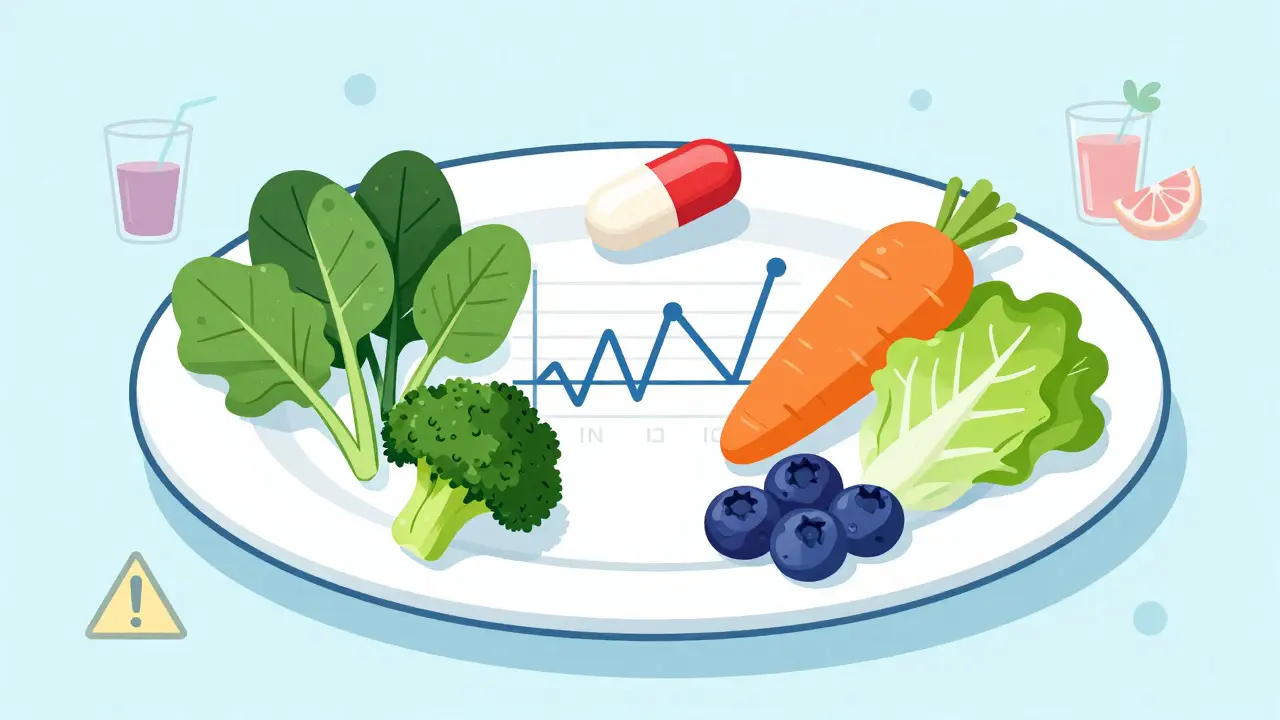
Not all greens are created equal. Here’s a breakdown of foods that can interfere with warfarin, grouped by vitamin K strength:
Very High Vitamin K (Over 500 mcg per 100g)
- Kale (817 mcg)
- Collard greens (623 mcg)
- Parsley (616 mcg)
- Seaweed (599 mcg)
- Spinach (483 mcg)
- Swiss chard (450 mcg)
- Turnip greens (421 mcg)
One cup of cooked spinach? That’s nearly 900 mcg of vitamin K. If you normally eat a salad with lettuce and suddenly swap it for a big bowl of spinach, your INR could plummet. Don’t quit spinach-just eat the same amount every day.
High Vitamin K (100-500 mcg per 100g)
- Broccoli (raw, 102 mcg)
- Brussels sprouts (177 mcg)
- Green tea (106 mcg)
- Asparagus (cooked, 70 mcg)
- Cabbage (cooked, 60 mcg)
- Edamame (50 mcg)
These are common in meals. A side of steamed broccoli or a cup of green tea might seem harmless. But if you drink green tea every morning and suddenly stop for a week, your INR can creep up. Same if you skip Brussels sprouts during holidays and then binge on them at Thanksgiving.
Medium Vitamin K (25-100 mcg per 100g)
- Lettuce (raw, 30 mcg)
- Green beans (25 mcg)
- Avocado (21 mcg)
- Blueberries (19 mcg)
- Carrots (13 mcg)
These are generally safe. You can eat them freely without worrying too much. But even here, consistency matters. If you go from eating blueberries daily to never eating them, your body adjusts-and your INR might shift.
Hidden Triggers: Juices, Supplements, and Alcohol
It’s not just vegetables. Some drinks and supplements are just as dangerous.
Cranberry Juice
One study found that drinking 8 ounces of cranberry juice daily raised INR by 1.0 to 2.0 units. One Reddit user saw their INR jump from 2.4 to 4.1 in just a few days. That’s a bleeding risk. Avoid it completely.
Grapefruit Juice
Grapefruit messes with the liver enzyme that breaks down warfarin. Even a small glass can increase your INR by 30%. If you’ve ever had a glass with breakfast, stop. It doesn’t take much.
Alcohol
More than two drinks a day lowers warfarin’s effectiveness. Heavy drinking can make your INR drop, raising your clot risk. But even moderate drinking on an empty stomach can spike your INR. Stick to no more than two drinks on two days a week-and never binge.
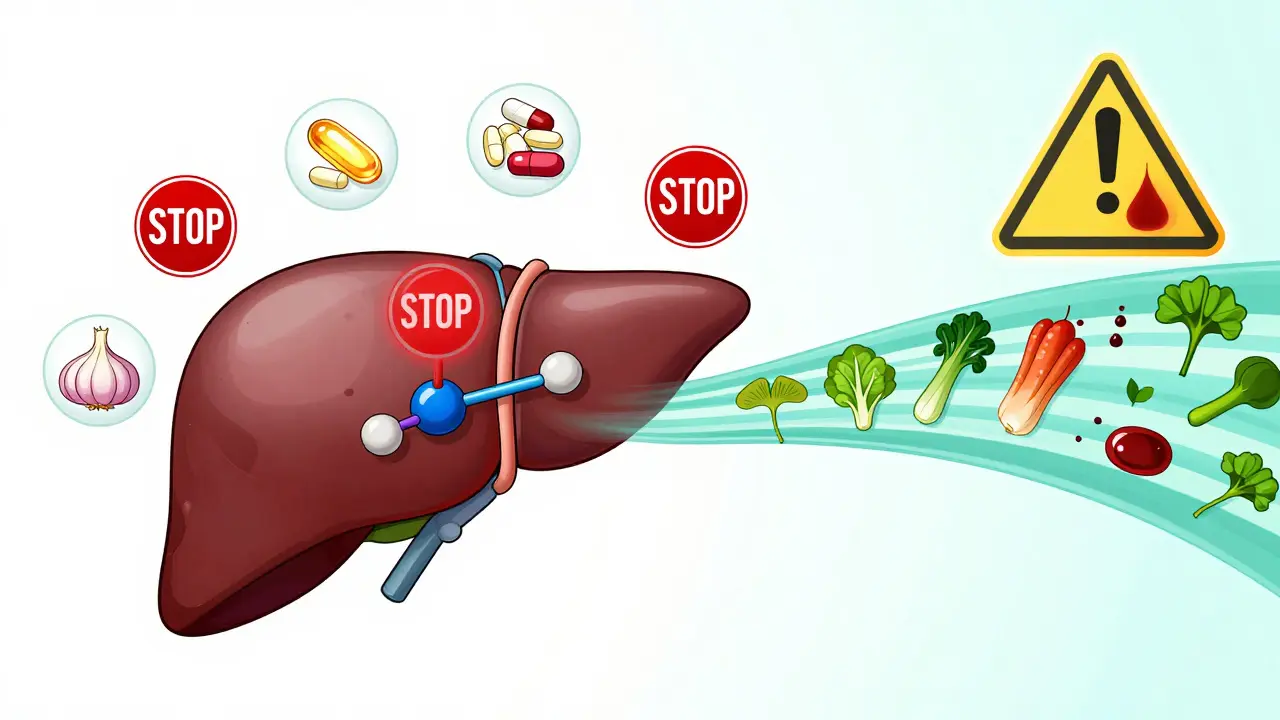
Supplements That Can Kill You
- Fish oil (omega-3): Increases bleeding risk by 25%. Avoid doses over 1,000 mg daily.
- Garlic supplements: Can raise INR by 0.8 to 1.2 units. Fresh garlic in food? Fine. Pills? Skip them.
- Ginkgo biloba: Doubles bleeding risk. Used for memory? It’s not worth it on warfarin.
- Coenzyme Q10: May reduce warfarin’s effect. Not proven, but too risky to try.
Always check with your anticoagulation clinic before taking any supplement-even “natural” ones.
Real Stories: What Works
One user on PatientsLikeMe, u/StableINR, kept their INR in range for 18 months by eating exactly one cup of spinach salad every single day. No more. No less. They didn’t avoid spinach-they mastered it.
Another user, u/WarfarinWarrior, had their INR spike after daily cranberry juice. They stopped it. Their INR dropped back to normal in three days.
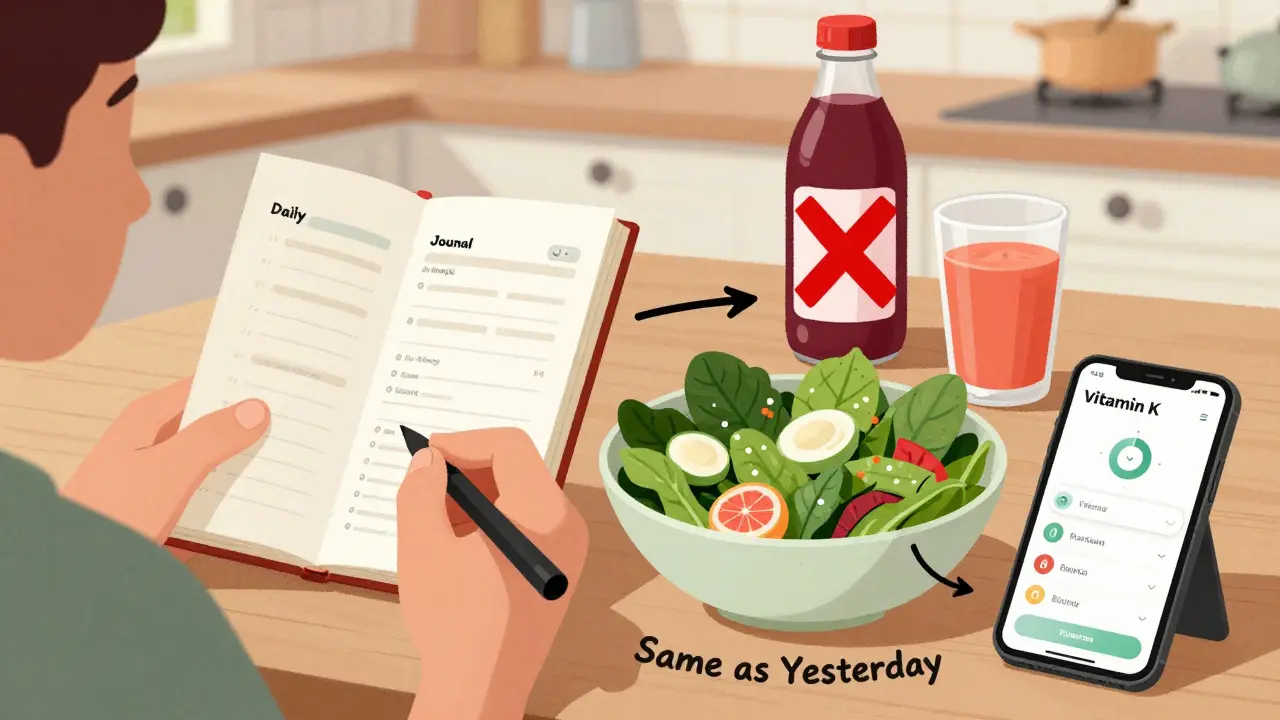
Studies show people who keep a food journal are 76% more likely to stay in their target INR range. Apps like MyFitnessPal let you track vitamin K intake. Set a goal: keep your daily vitamin K within 10-15% of your average. That’s it.
What to Do Every Day
Here’s your simple daily routine:
- Take warfarin at the same time every day. No skipping.
- Eat about the same amount of vitamin K every day. If you had kale yesterday, have kale today.
- Avoid cranberry juice, grapefruit juice, and alcohol beyond two drinks twice a week.
- Don’t start or stop any supplement without talking to your doctor.
- Log your meals in an app or notebook. Even a quick note helps.
Warning Signs: When to Call Your Doctor Immediately
Warfarin can cause bleeding. It’s not rare. Know the red flags:
- A cut that won’t stop bleeding after 5 minutes
- Bloody or black, tarry stools
- Severe headache or dizziness
- Unexplained bruising or swelling
- Red or pink urine
One in five warfarin users will have a bleeding event in a year. Most happen because of diet changes, missed doses, or new supplements. Don’t wait. Call your clinic or go to the ER if you see any of these.
The Bottom Line
You don’t need to eat bland food. You don’t need to give up greens. You just need to be consistent. The same amount of vitamin K every day. The same routine. The same awareness.
Warfarin is still the best choice for mechanical heart valves and many other conditions. It’s cheap. It’s proven. But it demands respect. Your food isn’t the enemy-it’s your partner in staying safe.
Stick to your plan. Track your meals. Talk to your anticoagulation team. And remember: stability isn’t luck. It’s discipline.
Can I eat spinach if I’m on warfarin?
Yes, you can eat spinach-but keep the amount consistent. One cup daily is fine. If you normally eat spinach and suddenly stop, your INR may rise. If you start eating a big bowl every day, your INR may drop. Consistency matters more than avoidance.
Does green tea affect warfarin?
Yes. Green tea contains about 106 mcg of vitamin K per 100g. Drinking one cup a day is usually okay if you’ve been doing it consistently. But if you start drinking three cups daily or suddenly quit, it can change your INR. Stick to your usual habit.
Is cranberry juice really that dangerous?
Extremely. Cranberry juice blocks the liver enzyme that breaks down warfarin, causing INR to spike. One case study showed an INR rising from 2.4 to 4.1 after daily consumption. Avoid it completely. Even "sugar-free" versions have the same effect.
Can I drink alcohol on warfarin?
Moderation is key. No more than two standard drinks on two days per week. More than that can lower warfarin’s effect and increase clot risk. Drinking on an empty stomach or binge drinking can spike INR and cause bleeding. When in doubt, skip it.
Should I take vitamin K supplements?
No. Unless your doctor specifically prescribes it, avoid vitamin K supplements. They can make warfarin less effective and increase your risk of clots. Get your vitamin K from food-consistently-not pills.
How often should I get my INR checked?
When you first start warfarin, you may need checks weekly. Once stable, every 2-4 weeks is typical. But if you change your diet, start a new medication, or get sick, get tested right away. Your INR can shift fast.
Are there apps to track vitamin K intake?
Yes. MyFitnessPal has a vitamin K tracker. Others like Cronometer and Fooducate also list vitamin K content. Log your meals daily. Patients who track their diet are 22% less likely to have out-of-range INR results.
What if I forget to take my warfarin?
If you miss a dose, take it the same day if you remember. If it’s already the next day, skip it and resume your normal schedule. Never double up. Call your anticoagulation clinic for advice. Missing doses is a top cause of clots.
Next Steps: What to Do Today
Start simple:
- Check your last INR result. Is it in range?
- Look at your last week of meals. Did you eat a lot of kale one day and none the next?
- Remove cranberry and grapefruit juice from your fridge.
- Download a food tracking app and log your meals for three days.
- Call your anticoagulation clinic and ask for a copy of their dietary guidelines.
Staying safe on warfarin isn’t about perfection. It’s about routine. You’ve got this.
13 Comments
pradnya paramita
Warfarin's narrow therapeutic index makes vitamin K consistency non-negotiable. The pharmacokinetics are heavily influenced by CYP2C9 and VKORC1 polymorphisms, so even minor dietary fluctuations can trigger supratherapeutic INR. Clinical guidelines from ACCP and AHA emphasize habitual intake over avoidance - the key is not elimination, but standardization. Tracking with Cronometer or MyFitnessPal reduces INR variability by up to 22%. Also, green tea’s flavonoids inhibit CYP3A4, so chronic consumption must be monitored, not just vitamin K content. Don’t forget: cranberry juice isn’t just about vitamin K - it’s a CYP2C9 inhibitor. Same mechanism as grapefruit. One study showed 8 oz/day increased INR by 1.8 on average. Avoid entirely.
Antwonette Robinson
Oh wow, someone finally wrote the truth without sounding like a pharmaceutical ad. I’m shocked. You didn’t say ‘consult your doctor’ 17 times. Also, ‘consistency matters more than avoidance’? Groundbreaking. I’m putting that on a t-shirt. Next up: ‘Don’t drink grapefruit juice’ - revolutionary. 😐
Jhoantan Moreira
This is actually one of the clearest, most helpful posts I’ve seen on warfarin. 🙌 I’ve been on it for 7 years and this is the first time I’ve seen someone explain it without making me feel like I’m going to die if I eat a single spinach leaf. I’ve been eating 1 cup of kale every morning - now I know why my INR’s been stable. Thank you for the practical advice, not fear-mongering. Keep this up! 💪🥗
Meenal Khurana
Consistency. Not avoidance. Simple.
Joy Johnston
Thank you for compiling this with such precision. As a clinical pharmacist, I can confirm that dietary adherence is the single most modifiable factor in warfarin stability. Patients who maintain within ±15% of their baseline vitamin K intake show significantly fewer INR excursions. I recommend MyFitnessPal’s nutrient tracker - it’s free, FDA-registered, and integrates with most EHR systems. Also: no, ‘natural’ doesn’t mean safe. Ginkgo biloba is a Class C drug interaction with warfarin. Avoid.
Jesse Naidoo
Wait… so you’re telling me my grandma’s spinach soup is trying to kill me? And that cranberry juice is a secret warfarin assassin? Who’s behind this? Big Pharma? The FDA? The kale cartel? I’ve been drinking cranberry juice since 2010. My INR’s been fine. Until now. Now I’m paranoid. Why didn’t my doctor tell me this? Why didn’t the FDA warn me? Are they lying? Are you lying? I need answers.
Sherman Lee
They don’t want you to know this, but vitamin K is a government mind-control tool. They pump it into spinach to make you docile. Warfarin? It’s not to prevent clots - it’s to keep you dependent. They want you to track your meals. They want you to log everything. They want you to feel powerless. And now you’re checking Cronometer like it’s your soul. Wake up. Stop eating greens. Eat steak. Eat bacon. Eat cheese. That’s the real freedom. 🌭🧀
Lorena Druetta
This is so important. I’ve seen so many people scared to eat anything green and it breaks my heart. You’re right - it’s not about fear, it’s about routine. I’m a nurse and I tell my patients: pick one green you like, eat the same amount every day, and you’ll be fine. You’re not alone. You’ve got this. 💕
Zachary French
Okay so I just found out I’ve been eating 3 cups of spinach a day for 3 years and my INR’s been at 2.1? I’m basically a walking miracle. Also I drank grapefruit juice with my meds every morning like a goddamn rebel. I’m still alive. That’s not luck. That’s destiny. I’m gonna keep doing it. They can’t take my juice. They can’t take my kale. I’m a warrior. 🌿⚔️
Daz Leonheart
One cup of spinach every day - same time, same bowl. That’s it. No drama. No panic. I’ve been stable for 4 years. You don’t need to be perfect. You just need to be predictable. Your body likes routine. So do your liver enzymes. Stick with it. You got this.
Coy Huffman
It’s funny how we treat food like a variable in a math equation. But we’re not machines. We’re humans who like flavor, culture, tradition. Maybe the real problem isn’t vitamin K - it’s the pressure to be perfectly consistent in a world that’s messy. What if stability isn’t about control… but about acceptance? Maybe the goal isn’t to track every microgram… but to find peace with the rhythm of your plate. 🌱
Kunal Kaushik
Bro I used to eat raw kale every day like it was a sport. Then I read this and switched to 1 cup spinach daily. INR stayed perfect. No drama. No panic. Just food. 😎
Mandy Vodak-Marotta
Okay so I’m gonna say something real. I’ve been on warfarin since my pulmonary embolism in 2020. I used to be terrified of every green thing. I’d stress over whether a salad had too much arugula. I’d Google ‘is broccoli dangerous?’ at 2 a.m. I was miserable. Then I found a dietitian who told me: ‘Pick one green. Eat the same amount every day. That’s it.’ I picked spinach. One cup. Every. Single. Day. No more anxiety. No more panic. No more 3 a.m. Google spirals. I don’t track it anymore. I just do it. And my INR? It’s been in range for 2 years. You don’t need to be perfect. You just need to be consistent. And honestly? That’s enough. 🙏